Why Advanced Astrophotographers Stop Using a Single Observatory (and Move to Multi-System Management)
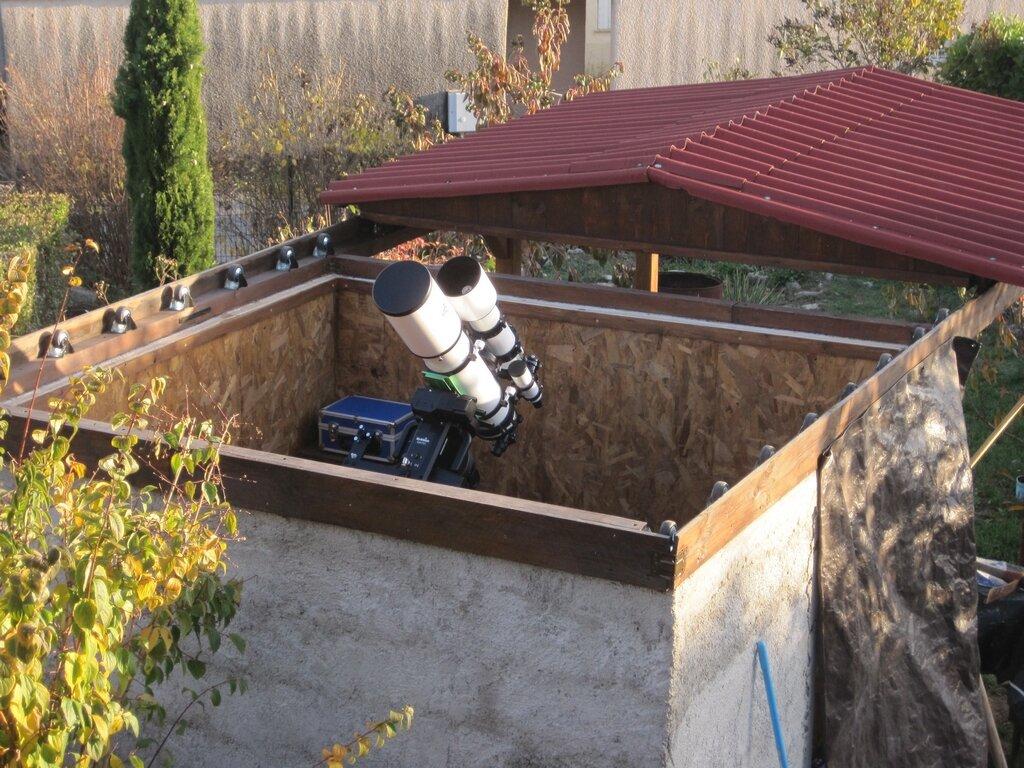
When people think about an automated observatory, they usually picture a single mount, one telescope, a roll-off roof, and a dedicated computer controlling the entire system.
For most amateur astronomers, this architecture is perfectly adequate. However, as needs evolve, an interesting question eventually arises:
Is it possible to control multiple independent observatories from a single computer?
Surprisingly, this topic is rarely discussed within the amateur astronomy community, even though it opens up exciting possibilities for astronomy clubs, associations, and experienced astrophotographers.
The Traditional Model: One PC per Observatory
Traditionally, each observatory operates with its own dedicated computer.
This approach offers several advantages:
- Simple configuration
- Complete independence between installations
- Easier maintenance
- Minimal risk of interaction between systems
However, this architecture also has limitations.
As the number of observatories increases, so does the need to manage:
- Additional computers
- Software licenses
- Operating system updates
- Backups
- Power supplies
- Hardware maintenance
For astronomy clubs or astrophotographers operating multiple installations, this growing amount of equipment can quickly become cumbersome.
A Different Approach: Centralizing Multiple Observatories on a Single PC
Advances in automation software now make it possible to consider a different architecture.
The idea is to use a sufficiently powerful computer capable of supervising several independent observatories simultaneously.
Each observatory retains its own:
- Mount
- Telescope
- Camera
- Roof opening system
- Accessories
But overall management is consolidated into a single control platform.
This approach offers several often-overlooked advantages.
Optimizing Computing Resources
Modern astrophotography software typically uses only a fraction of the processing power available on today’s computers.
As a result, a modern PC can often manage multiple systems simultaneously without significant difficulty.
Instead of running several computers at low utilization, resources can be consolidated onto a single machine.
The result:
- Less hardware
- Lower power consumption
- Reduced maintenance
- Simplified administration
Running Multiple Imaging Sessions in Parallel
The benefits become even more apparent when multiple specialized instruments are available.
For example:
- A wide-field refractor dedicated to large nebulae
- A long focal length telescope optimized for galaxies
- A planetary imaging setup
- An instrument dedicated to photometry or scientific observations
Each installation can operate simultaneously on a different target.
While one telescope captures several hours of exposure time on a nebula, another can image a galaxy, and a third can track an entirely different object.
This strategy can dramatically increase the overall productivity of an observing night.
A Particularly Interesting Solution for Astronomy Clubs
Astronomy clubs often own multiple instruments.
Yet simultaneous use of these systems is sometimes limited by operational complexity.
A multi-observatory architecture can, for example:
- Assign one instrument to astrophotography
- Dedicate another to Electronically Assisted Astronomy (EAA)
- Reserve a third for public demonstrations
- Use a fourth for educational projects
Each system operates independently while remaining supervised from a central platform.
This organization can simplify equipment management while improving overall utilization.
The Challenges of a Multi-Observatory Architecture
Such an approach naturally requires certain precautions.
The logical separation of equipment must be carefully designed to avoid any unintended interactions between systems.
Each observatory must maintain:
- Its own configuration settings
- Its own hardware devices
- Its own imaging sequences
- Its own safety mechanisms
The reliability of the software environment therefore becomes a critical element of the overall architecture.
Aurora 2.0: Up to 4 Independently Controlled Roll-Off Roofs from a Single PC
This multi-observatory architecture is not limited to astrophotography software. Roll-off roof control can also be centralized.
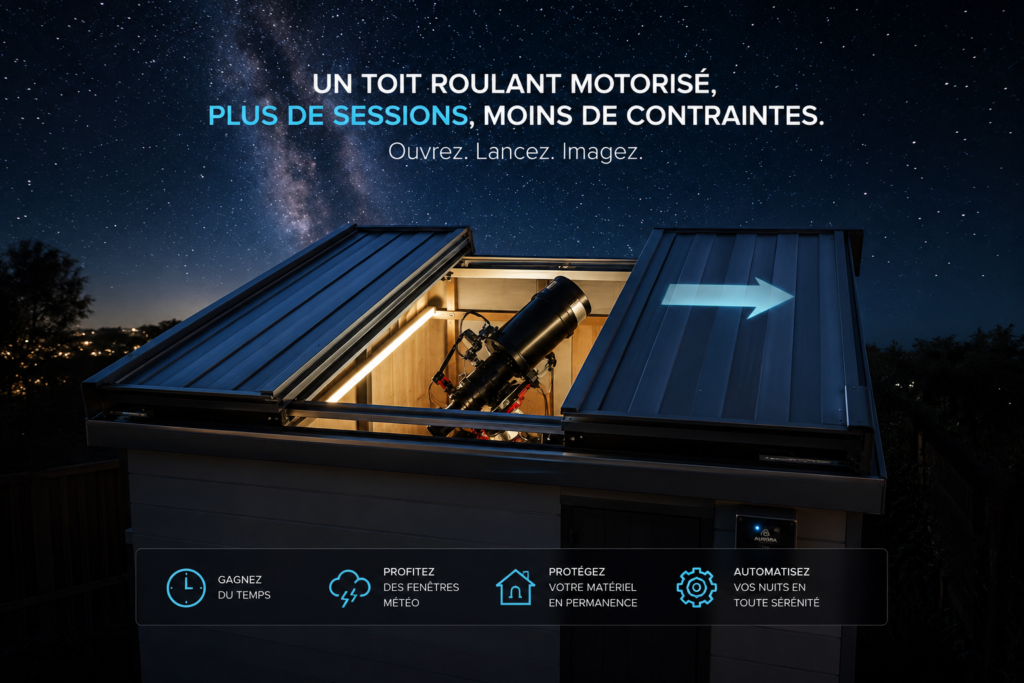
This is precisely the approach taken with Aurora 2.0, the roll-off roof controller designed for amateur astronomical observatories.
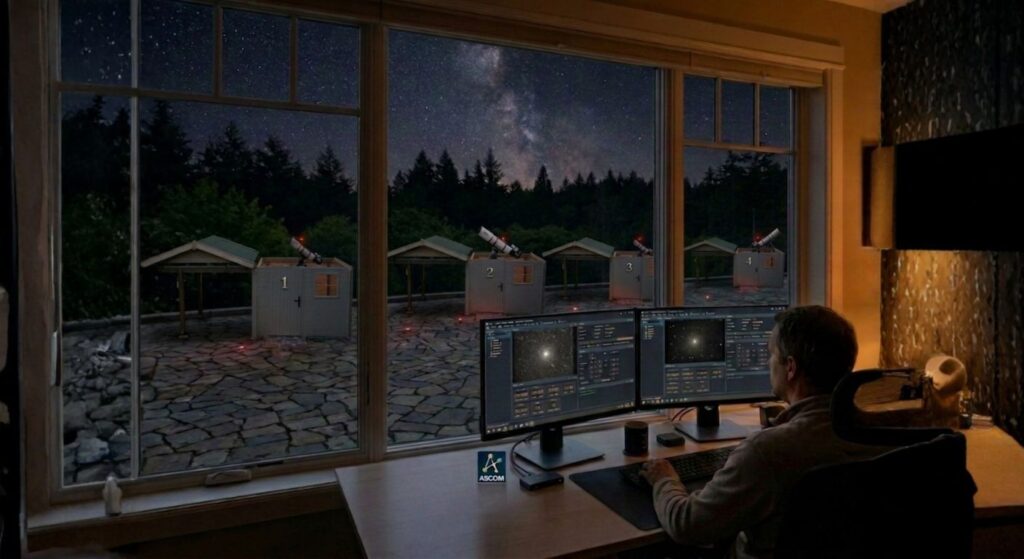
Its driver allows you to control up to four Aurora 2.0 units independently and simultaneously from a single PC.
In practical terms, a single computer can therefore supervise multiple observatories while maintaining completely independent control of each installation.
For example:
- Aurora 2.0 #1 controls the roof of the first observatory;
- Aurora 2.0 #2 controls the roof of the second observatory;
- Aurora 2.0 #3 controls the roof of the third observatory;
- Aurora 2.0 #4 controls the roof of the fourth observatory.
Each roof can therefore be controlled separately, according to the needs of the instrument and the observing session.
This architecture eliminates the need to add a separate computer solely to control each observatory’s roof.
It is therefore perfectly suited to installations where multiple instruments operate simultaneously: each observatory remains independent, while their supervision can be centralized on a single machine.
Centralization Without Losing Independence
The key advantage of this architecture is that it does not turn multiple observatories into a single system.
Each installation retains its own equipment and configuration. The central PC simply supervises the different systems.
For an astronomy club with several observing stations, or for an astrophotographer operating multiple installations, this setup can significantly simplify day-to-day management.
A single PC can therefore supervise up to four Aurora 2.0 controllers, each independently operating its own roll-off roof.
This is a particularly interesting approach when the goal is to build a scalable astronomical infrastructure capable of operating multiple observatories in parallel.
A Trend That Remains Largely Untapped
Despite its potential, simultaneous management of multiple observatories remains relatively uncommon in amateur astronomy.
Most current solutions have historically been designed around the concept of “one observatory, one computer.”
However, as automation becomes increasingly accessible and equipment costs continue to decrease, user requirements are gradually evolving.
Astronomy clubs are developing more ambitious infrastructures, while some specialized astrophotographers operate multiple instruments simultaneously to maximize their productivity under clear skies.
In this context, the ability to manage multiple independent observatories from a single machine may become an increasingly desirable feature in the years ahead.
The Future of Amateur Observatories?
Automation has transformed astrophotography over the past decade.
After automating image acquisition, focusing, guiding, meridian flips, and even observatory operation itself, a new stage now appears to be emerging: the simultaneous management of multiple independent installations.
For enthusiasts who own several instruments—or for astronomy clubs seeking to optimize their infrastructure—this approach offers particularly exciting possibilities.
One thing is certain: as amateur observatories become smarter and more autonomous, the question may no longer be how to automate a single observatory, but rather how to efficiently supervise several of them.
Conclusion
Managing multiple observatories from a single PC is no longer a theoretical concept. With modern computing power and advanced automation software, it is becoming an increasingly realistic option for ambitious amateur astronomers and astronomy organizations.
By centralizing operations, reducing hardware requirements, and maximizing instrument utilization, a multi-observatory architecture can significantly increase productivity while simplifying day-to-day management.
As observatory automation continues to evolve, centralized control may well become one of the next major steps in the future of amateur astronomy.
Subscribe to our newsletter
Get early access to our latest articles, practical tips for your astronomical observatory, and exclusive offers.