How many weekends are you willing to sacrifice to open your roof with a single click?
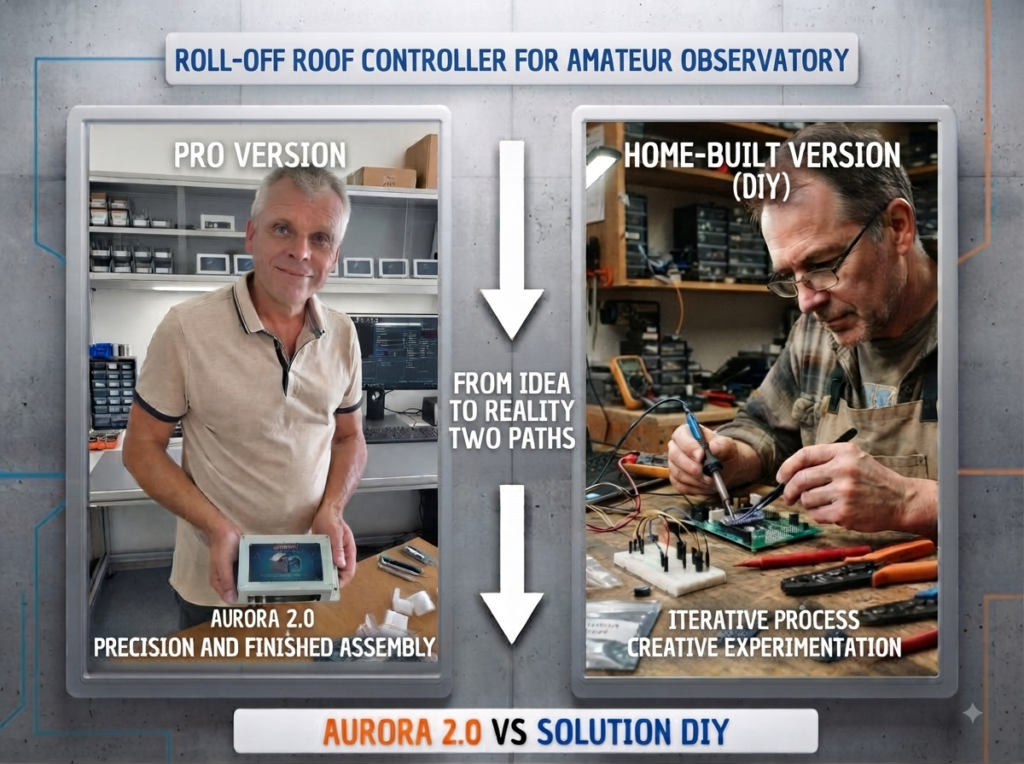
That’s the real question behind the DIY vs. commercial solution debate. In the amateur observatory community, DIY isn’t a fallback solution — it’s often a source of pride. Arduino, IPX800, custom ASCOM drivers: hundreds of astrophotographers have built their own systems, documented on forums such as Webastro and Astrosurf, and they work.
So the question isn’t “Is DIY reliable?” — the answer is probably yes, when it’s properly designed and built. The real question is: what does it actually cost, and who is this solution right for?
What a DIY Solution Really Costs
On paper, an IPX800 board (€150–€250 depending on the version), a few magnetic limit switches (€20–€40), an enclosure, wiring, and a power supply often bring the component cost to around €250–€400, well below the €849 price of Aurora 2.0.
What this figure doesn’t show is the time involved.
Writing or adapting an ASCOM driver for a roll-off roof (ASCOM natively supports domes, but not roll-off roofs — so the “Dome” object has to be adapted), configuring the IPX800, testing every sensor, troubleshooting false contacts, and adjusting motor timing: on specialized forums, these are projects that often stretch over several months, between weekends and evenings.
That’s not a problem if you enjoy the process — many enthusiasts genuinely do. But if your goal is to photograph the sky rather than develop a control system, that time has a real cost, even if it doesn’t appear on any invoice.
What Happens When Something Fails?
It’s a question we rarely ask before getting started. With a DIY system, technical support is you — or the community, with its variable response times. A malfunctioning sensor, a driver that crashes after a Windows update, a failed relay: you either troubleshoot it yourself or post on a forum and wait for an answer.
There’s also a less visible reality: even when you find a “ready-to-use” ASCOM driver online or an electronic circuit already validated by other users, you don’t always know what is actually happening under the hood. Does the driver properly handle every possible error condition? What happens if communication is interrupted, if a sensor returns inconsistent information, or if the PC freezes? On the electronics side, have protections against electrical noise, voltage surges, contact bounce, or electromagnetic interference been implemented and properly tested? Without analyzing the source code and hardware design yourself, it is often impossible to answer these questions.
The Comparison, With the Numbers
| DIY Solution (IPX800/Arduino) | Aurora 2.0 | |
|---|---|---|
| Component cost | €250–€400 | €849 |
| Implementation time | Several weeks to several months | A few hours |
| ASCOM driver | Write or adapt it yourself | Included, tested, and updated |
| Roof/telescope anti-collision safety | Designed and validated by you | Integrated into the driver from the design stage |
| Support in case of failure | Forums, community, variable response times | French-language support, warranty |
| Customization | Unlimited | Designed for standard use |
| Ideal for | Electronics and coding enthusiasts | Those who want to observe, not code |
This table doesn’t say that one column is “better” than the other — it simply shows where your money goes, and where your time goes.
Reliability and Safety: The Difference Isn’t in the Components, It’s in the Design
A well-designed DIY system — redundant sensors, obstruction detection, roof/telescope anti-collision safety — can be just as reliable as a commercial solution, provided all these scenarios have been considered from the very beginning. Unfortunately, many DIY projects only discover the importance of these safeguards after a first incident.
Aurora 2.0 incorporates these protections from the outset, tested before you ever need them in the middle of the night. Beyond the components themselves, it is the overall architecture that has been designed to anticipate exceptional situations: loss of communication, sensor failure, emergency stops, or unexpected system behavior. This overall validation is what distinguishes a finished product from an assembly, even a very well-made one.
This is where the real difference with Aurora 2.0 lies: it’s not a product that is inherently more “intelligent” than a well-designed IPX800 setup. It is a product designed, tested, and documented by someone else, with French-language support and a warranty behind it. You’re not paying for the technology itself — an IPX800 can technically do the job — you’re paying so you don’t have to be your own technical support department when something goes wrong.
When DIY Is Still the Right Choice
Let’s be direct: if you have the time, the desire to learn, and the project itself interests you just as much as the observation, DIY remains an excellent option — less expensive, infinitely customizable, and extremely educational. Many excellent amateur observatories have been running for years on home-built systems.
When Aurora 2.0 Makes More Sense
If your free time is already entirely dedicated to observing or astrophotography rather than development, if you want a solution that works from installation without a lengthy tuning phase, or if you would rather have technical support and a warranty than depend on a forum when something goes wrong, then Aurora 2.0 is designed precisely for that need.
Its value isn’t that it outperforms an excellent DIY build. Its value is that it provides a complete, designed, tested, documented, and maintained system, allowing you to focus on astrophotography rather than on developing the infrastructure that makes it possible.
Frequently Asked Questions
Does Aurora 2.0 work with N.I.N.A. and ASCOM? Yes. Aurora 2.0 is natively compatible with N.I.N.A. and ASCOM, without complex configuration.
Can IPX800 and Aurora 2.0 be combined? Aurora 2.0 is a standalone system designed to completely replace an IPX800/Arduino setup dedicated to a roll-off roof, rather than complement it.
How long does it take to install Aurora 2.0? Unlike a DIY project that can stretch over several months, Aurora 2.0 can be installed within a few hours.
What if your observatory project is ready to take the next step?
Ultimately, the choice between a DIY solution and a commercial solution depends less on the technology itself than on how you want to spend your time.
If you enjoy building your own system, DIY can be a highly rewarding project.
But if your goal is to have an automated, reliable observatory that can evolve with your astrophotography setup, Aurora 2.0 lets you focus on what matters: opening your roof, starting your session, and enjoying the night sky.
Already have an observatory project in mind? Are you still at the planning stage, or has construction already begun?
Now may be the right time to consider roll-off roof control as part of your observatory design.
Discover Aurora 2.0 and see how you can automate the roll-off roof of your observatory.
If you’d like to enjoy exclusive offers and be among the first to discover our latest articles, subscribe to our newsletter.