There is a scene many astrophotographers know by heart.
The sky finally clears.
The weather forecast shows a few usable hours.
But it is already late.
And then a familiar question comes up:
“Do I really have the energy to set everything up tonight?”
The tripod,
the mount,
the telescope,
the cables,
the computer,
polar alignment,
the settings,
and then monitoring the night… before sometimes packing everything away at 2 or 3 a.m.
Over time, many enthusiasts realize the issue is not motivation.
The real problem is logistics.
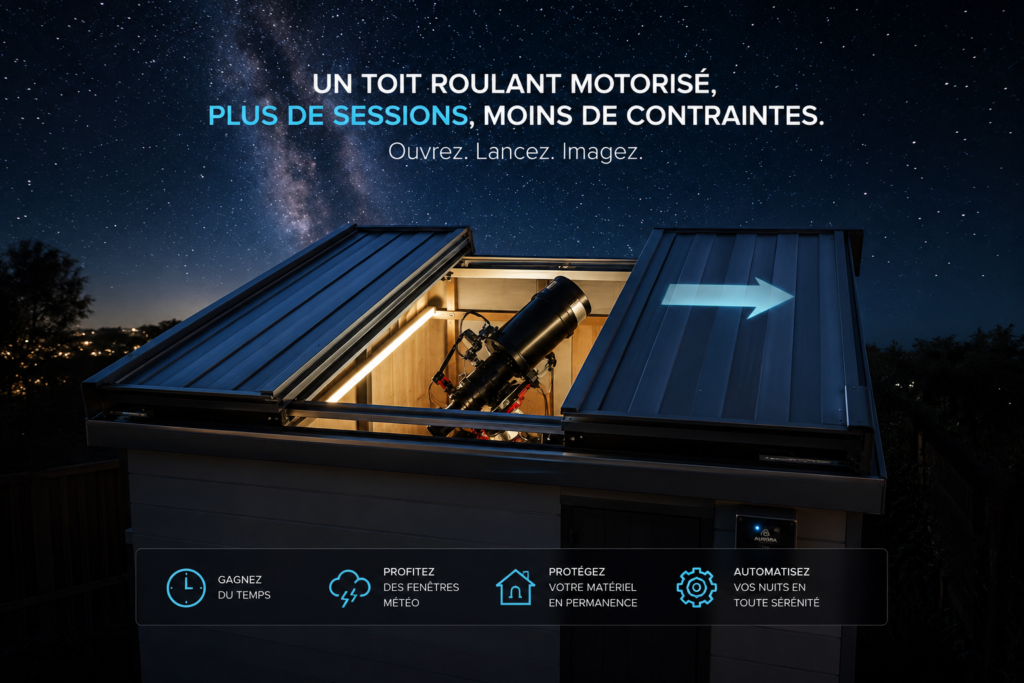
This is exactly where an observatory with a motorized roll-off roof can completely transform astrophotography practice.
And contrary to popular belief, this type of setup is now much more accessible than most people imagine.
Why many astrophotographers take fewer sessions than they would like
Astrophotography already requires patience, time, and personal investment.
But what often limits the number of sessions is not the equipment itself.
It is everything that must be done before imaging even begins.
Logistical fatigue becomes a real limitation
Even with a well-optimized setup, setting up the equipment requires energy.
Each session often involves:
transporting equipment,
reconnecting everything,
checking balance,
restarting the system,
securing the setup before going to sleep.
At first, this is part of the enjoyment.
But over time, many astrophotographers become more selective simply because setup becomes tiring.
Weather becomes a psychological barrier
How many sessions are canceled due to uncertain weather?
Even when a few hours are potentially usable, many hesitate:
cloud risk,
humidity,
fear of having to pack everything quickly,
fatigue linked to overnight monitoring.
As a result, potentially excellent nights are often lost before they even begin.
Nighttime wake-ups reduce enjoyment
Waking up at 1 or 2 a.m. to open or close a setup can quickly become exhausting.
And when astrophotography starts to impact sleep or daily life, sessions naturally become less frequent.
What a motorized roll-off roof really changes in daily use
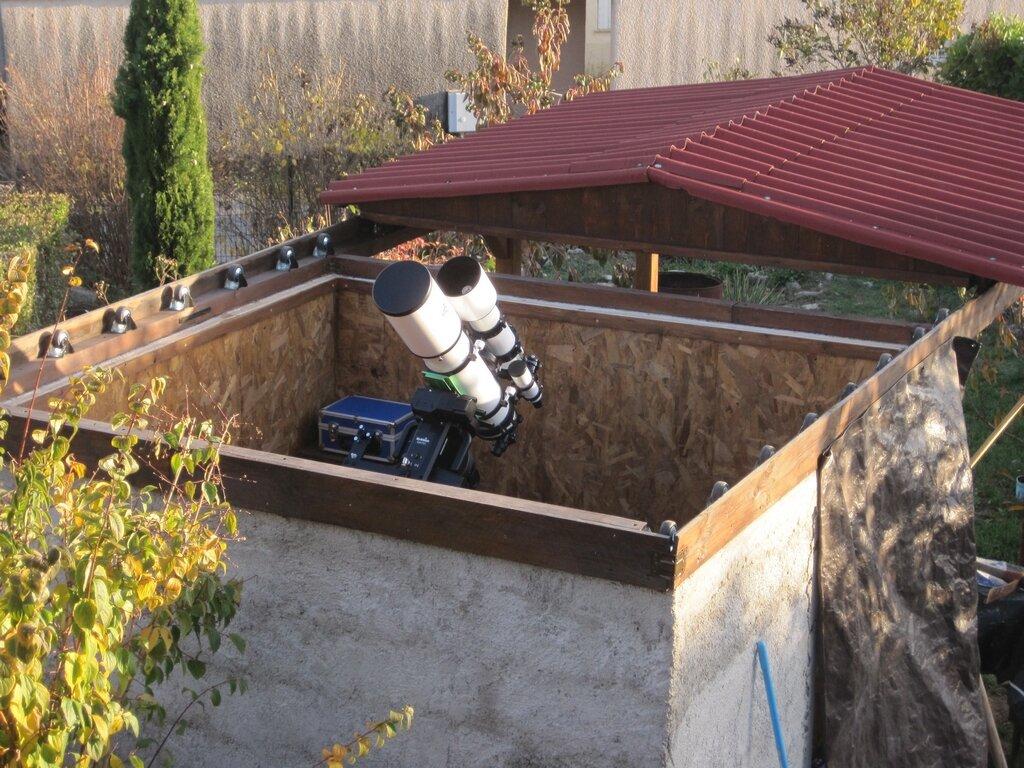
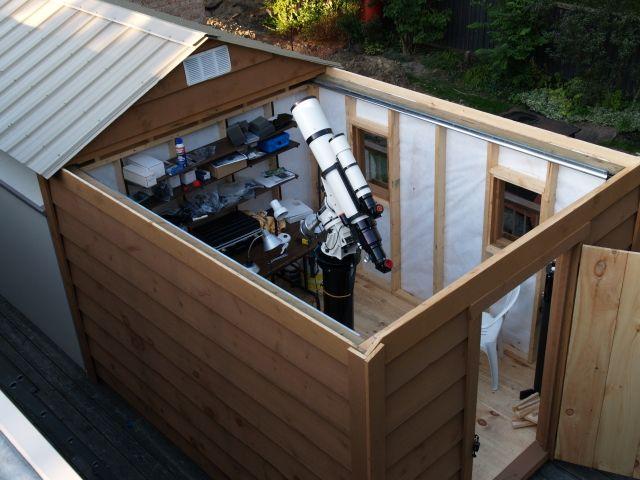
When a setup remains permanently installed in an observatory, the experience changes completely.
And this is often when astrophotographers start increasing their number of sessions again.
🚀 What if your observatory were always ready for imaging?
A permanent setup significantly reduces the time and effort required before each session.
With Aurora 2.0, you can automate the control of your roll-off roof and take advantage of available weather windows more easily.
👉 Discover Aurora 2.0, the smart controller for your roll-off roof
A session can start in just a few minutes
The equipment is already in place.
The mount stays installed.
Connections are permanent.
Settings are preserved.
Instead of a long setup process, you can simply:
open the roof,
launch the session,
start imaging quickly.
This simplicity changes everything in day-to-day practice.
You finally take advantage of short weather windows
This is one of the biggest benefits.
Before, a two-hour clear window did not always feel “worth it”.
With an automated observatory, that same window becomes an immediate opportunity.
You no longer spend as much time setting up as you do capturing data.
As a result, you use the sky much more often.
Automation brings real comfort
Today, a motorized roll-off roof can be controlled directly from an ASCOM-compatible environment.
The goal is not necessarily full autonomy from the start.
But rather:
simplifying opening and closing,
securing movements,
saving time,
reducing fatigue,
making sessions smoother.
Solutions such as the AURORA 2.0 roll-off roof controller make it possible to automate and secure observatory roof control in a much more accessible way than before.
🔭 A solution for automating your roll-off roof
Solutions like Aurora 2.0 allow you to automate the control of your observatory’s roll-off roof and integrate it into an ASCOM-compatible astronomy environment.
The goal is simple: open, close, and manage your roll-off roof more easily, while incorporating the necessary safety conditions for its operation.
Astrophotography becomes spontaneous again
And this is often the real change.
When starting a session becomes easy, you image more.
Even a short weather window becomes usable.
The observatory stops being a “complex project” and becomes a tool that serves the joy of observing and photographing the sky.
Is it complicated to install?
This is probably the biggest concern for astrophotographers discovering this type of solution.
Many still believe that automated observatories are reserved for complex professional installations.
This is no longer necessarily true.
Automation has become much more accessible
Modern solutions now allow many amateurs to build evolving observatories:
ASCOM compatible,
progressively motorized,
easily controllable,
adaptable to different setups.
Even DIY observatories can now integrate advanced features once reserved for high-end systems.
You can start simple
An automation project does not need to be completed all at once.
Many astrophotographers start by:
building a shelter,
adding a roll-off roof,
then gradually motorizing the system.
This approach spreads out the cost and allows the observatory to evolve at its own pace.
How much does a motorized roll-off roof observatory really cost?
This is often the first question.
And many people assume it is far beyond reach.
However, the reality is often much more accessible.
There are several budget levels
Depending on the level of automation, costs can vary significantly.
- Small DIY motorized observatory: a few hundred to ~1500€
- Advanced amateur observatory: ~2000 to 6000€
- High-end installation: higher budget range
In many cases, investment can be progressive.
It should also be compared to existing equipment
An astrophotography setup often represents several thousand euros:
mount,
camera,
optics,
computer,
accessories.
Automating an observatory also means:
protecting this equipment,
using it more often,
getting more value from your investment.
And most importantly: how much is an extra year of sessions worth?
That is probably the real question.
If a motorized roll-off roof allows you to:
start sessions more easily,
use more weather windows,
reduce fatigue,
image more regularly,
then the benefit is not only comfort.
It is experience, progress, and results.
Who benefits most from a motorized roll-off roof?
This type of setup can be especially valuable for:
astrophotographers with limited time,
heavy or complex setups,
users who often miss weather opportunities,
people wanting more regular sessions without added fatigue.
🔭 Want to make the most of your astrophotography nights?
Receive our upcoming tips on amateur observatories, motorized roll-off roofs, automation, and remote astrophotography.
Practical advice to help you build an observatory that is simpler, more reliable, and above all… used more often.
👉 Receive our latest articles directly by email
Automating an observatory: luxury or logical evolution?
For a long time, automated observatories seemed reserved for high-end installations.
Today, things are changing quickly.
Automation is becoming a simpler, more comfortable, and more efficient way to practice astrophotography.
And often, the best setup is not the most expensive one.
It is the one you actually use the most.
Conclusion
Many astrophotographers already own excellent equipment… but do not image as often as they would like.
Not because of lack of passion.
But because logistics sometimes limit sessions.
A motorized roll-off roof does not only automate an observatory.
It makes astrophotography:
simpler,
more regular,
less tiring,
and much more enjoyable in daily use.
And that is often what ultimately allows you to enjoy the sky much more often.
🌌 What if you could finally make the most of every usable night?
A motorized roll-off roof does more than simply protect your equipment.
It can transform the way you practice astrophotography by making it easier to take advantage of short weather windows and significantly reducing the amount of setup and handling required.
With Aurora 2.0, you can automate the control of your roll-off roof and take your observatory to the next level with a more comfortable and autonomous setup.
👉 Discover Aurora 2.0 and automate your roll-off roof