For many astronomy enthusiasts, owning a personal observatory feels like a dream reserved for experts.
We imagine:
complex systems,
electronics skills,
programming,
expensive installations.
And yet, the reality has changed dramatically in recent years.
Today, building an amateur astronomical observatory with an automated roll-off roof has become a much more accessible project than before, even for someone who is neither an engineer nor an automation specialist.
If you enjoy observing the sky but:
spend too much time setting up your equipment,
miss clear nights,
or dream of a ready-to-use setup in your garden,
then this article might completely change your perspective.
Why more and more amateurs are building their own astronomical observatories
Amateur astronomy has evolved enormously.
Telescopes are more powerful, software has become easier to use, and astrophotography attracts more and more enthusiasts.
But one problem remains familiar to every amateur astronomer:
👉 setting up and packing away equipment for every session.
Between:
tripod,
mount,
telescope,
cables,
power supply,
polar alignment,
weather conditions,
many end up observing or imaging less often than they would like.
That is exactly why more and more enthusiasts choose to build a small observatory in their garden.
An amateur observatory is much simpler than it seems
When people hear “automated observatory,” they often imagine something highly technical.
In reality, most modern amateur observatories rely on a fairly simple structure:
a fixed shelter,
a roll-off roof,
a permanently installed telescope,
and a system to open or close the roof.
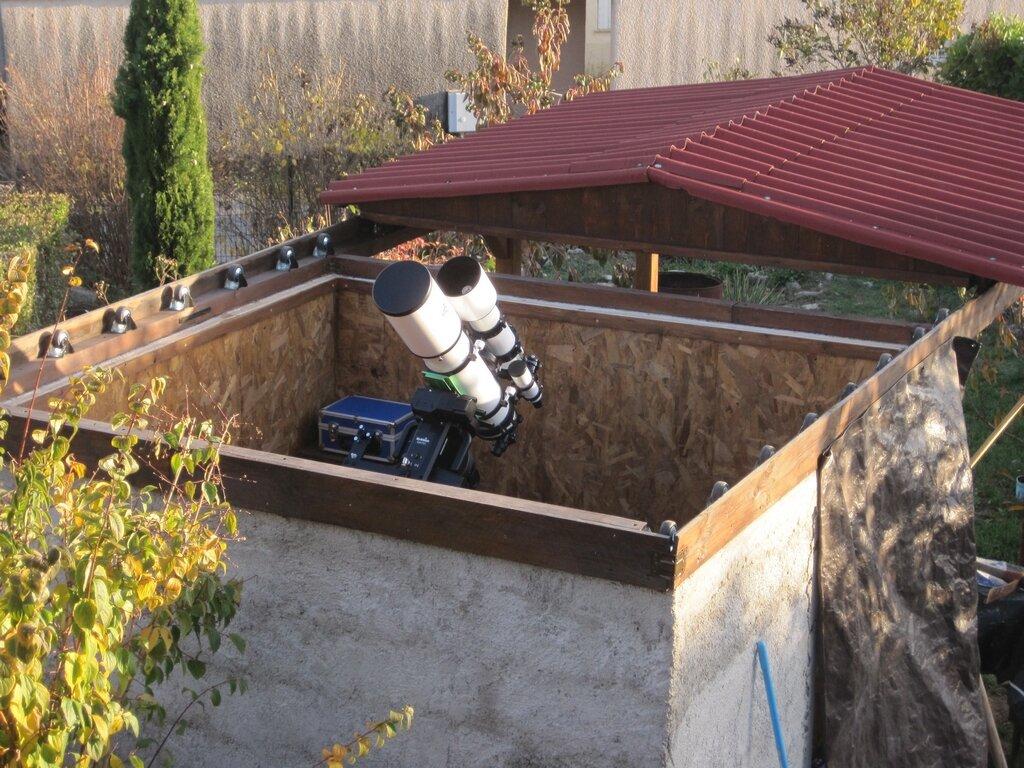
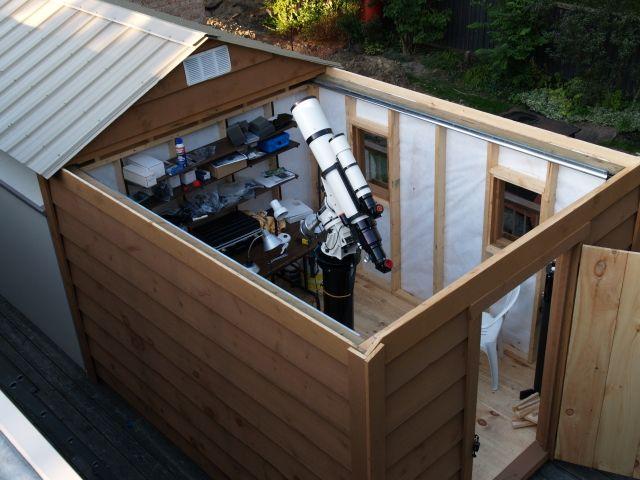
In most cases, it is simply a small wooden garden shed adapted for astronomy.
The real advantage is huge:
✅ no need to set up equipment
✅ better system stability
✅ more time under the stars
✅ less fatigue
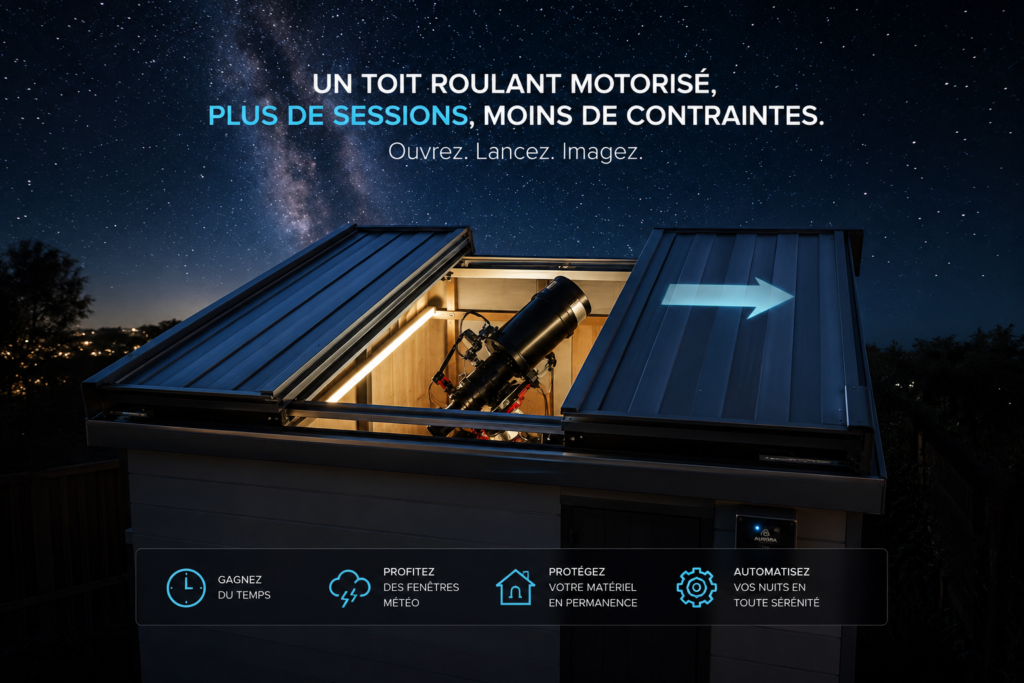
The roll-off roof: the preferred solution for amateur astronomers
The most popular system today is the roll-off roof observatory.
Why?
Because it combines:
simplicity,
reliability,
reasonable cost,
and easy automation.
The principle is simple:
The roof slides on rails to fully expose the sky above the telescope.
Unlike traditional dome observatories:
cost is lower,
construction is easier,
maintenance is reduced,
automation is often simpler.
Do you need to be a DIY expert to build an observatory?
The honest answer: a little… but not as much as you might think.
If you can:
use basic tools,
follow a simple plan,
assemble a wooden structure,
or get a bit of help,
then the project becomes entirely achievable.
Today, the internet is full of resources and plans shared by enthusiasts.
And this is often where many people are surprised:
👉 the mechanics are usually much simpler than they imagined.
The real shift: automation has become accessible
A few years ago, automating an observatory often required:
self-programming,
building custom electronics,
complex wiring,
or DIY solutions.
This is no longer necessarily the case today.
Modern systems now allow roll-off roof observatories to be controlled in a much simpler and safer way.
The goal is no longer to “build a complex machine.”
The goal is to:
✅ enjoy the sky more easily
✅ protect your equipment
✅ save time
✅ automate without stress
To simplify observatory automation, new plug-and-play solutions are now appearing on the market.
Systems such as AURORA 2.0 by AstroRemote Systems, for example, are designed to control a roll-off roof observatory in a simpler way, without needing to develop complex electronics yourself.
Essential components of an automated observatory
1. A stable structure
Most amateur astronomers use:
a wooden shed,
a reinforced shelter,
or a dedicated small building.
Main goal:
protect equipment long-term.
2. A reliable roll-off roof
The system must be:
robust,
simple,
safe,
and able to operate reliably for years.
Mechanical simplicity is often the best solution.
3. A motor system
Options include:
garage door motors
or
sliding gate motors
4. A roof control system
This is where the observatory controller comes in.
Its role:
open and close the roof,
manage safety systems,
read position sensors,
and communicate with astronomy software.
Today, modern solutions make this much simpler than before.
For example, controllers such as
👉 AstroRemote Systems – AURORA 2.0
are designed to simplify amateur observatory automation with a plug-and-play approach.
What holds most amateurs back… is not technical skill
The biggest barrier is often psychological.
Many people think:
“I’m not skilled enough,”
“it must be too complicated,”
“I’m not an engineer.”
Yet most amateur observatories operate with:
rails,
rollers,
a motor,
basic safety systems,
and a suitable controller.
The goal is not to build a space station.
It is simply to make astronomy more comfortable and more consistent.
Common beginner mistakes
Trying to make it too complex
Many projects become difficult because people try to:
over-automate everything,
add too many features,
design everything at once.
Starting simple is often the best strategy.
Underestimating mechanical simplicity
A good observatory is often based on:
solid rails,
a stable structure,
and a reliable system.
Mechanics matter more than electronics.
Subscribe to our newsletter
Get early access to our latest articles, practical tips for your astronomical observatory, and exclusive offers.
Waiting for the “perfect moment”
Many enthusiasts postpone their project for years, even though a simple observatory could already transform their astronomy practice.
Why an observatory completely changes the experience
This is probably the most important point.
When the equipment is permanently installed:
you observe more often,
you take advantage of short weather windows,
you start imaging sessions more easily,
and astronomy becomes much more enjoyable.
For many amateurs, building a personal observatory marks a real turning point in their passion.
Building a home observatory: yes, it is possible
No, you do not need to be an engineer.
No, you do not need an ultra-complex system.
And no, automation is no longer reserved for specialists.
With:
a simple structure,
a reliable roll-off roof,
and modern solutions designed for amateur astronomers,
it is now entirely possible to build a personal observatory that is accessible, scalable, and comfortable.
And once you try it…
it becomes very hard to go back.
FAQ – Amateur astronomical observatory
What budget is needed to build an amateur observatory?
The budget varies greatly depending on:
size,
materials,
automation level,
and motor system.
Many amateur projects start simple and evolve over time.
What is the best type of amateur observatory?
The roll-off roof is one of the most popular options due to its simplicity and ease of automation.
Can you automate an observatory without being a programmer?
Yes. Modern solutions greatly simplify automation, and some are designed as plug-and-play systems.
Why build an observatory in your garden?
Because it allows you to:
save time,
protect equipment,
observe more often,
and immediately take advantage of good weather conditions.