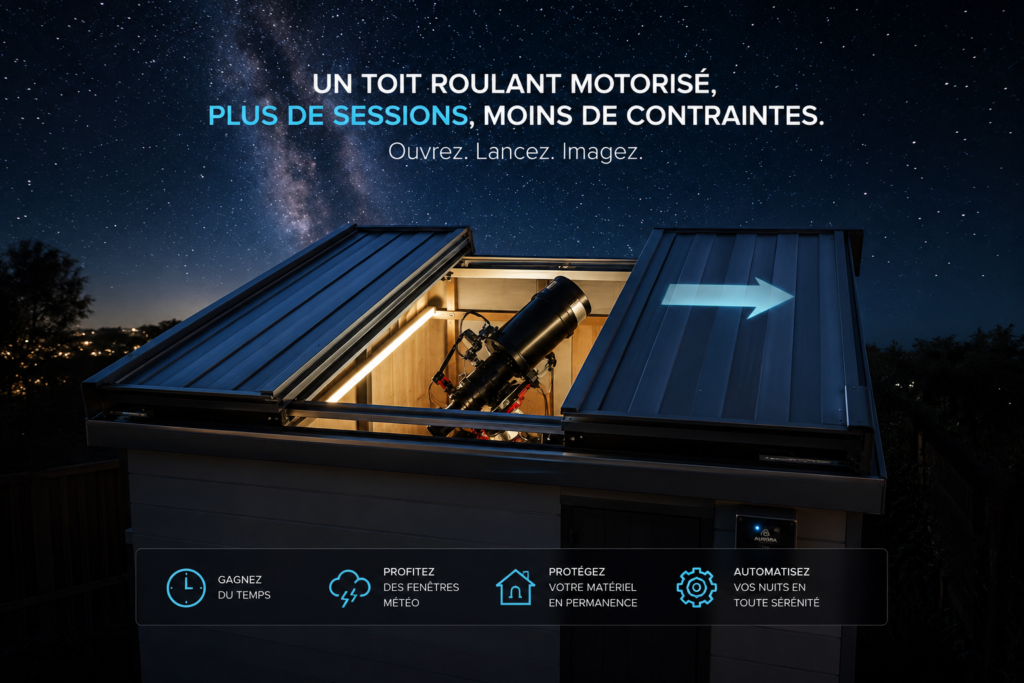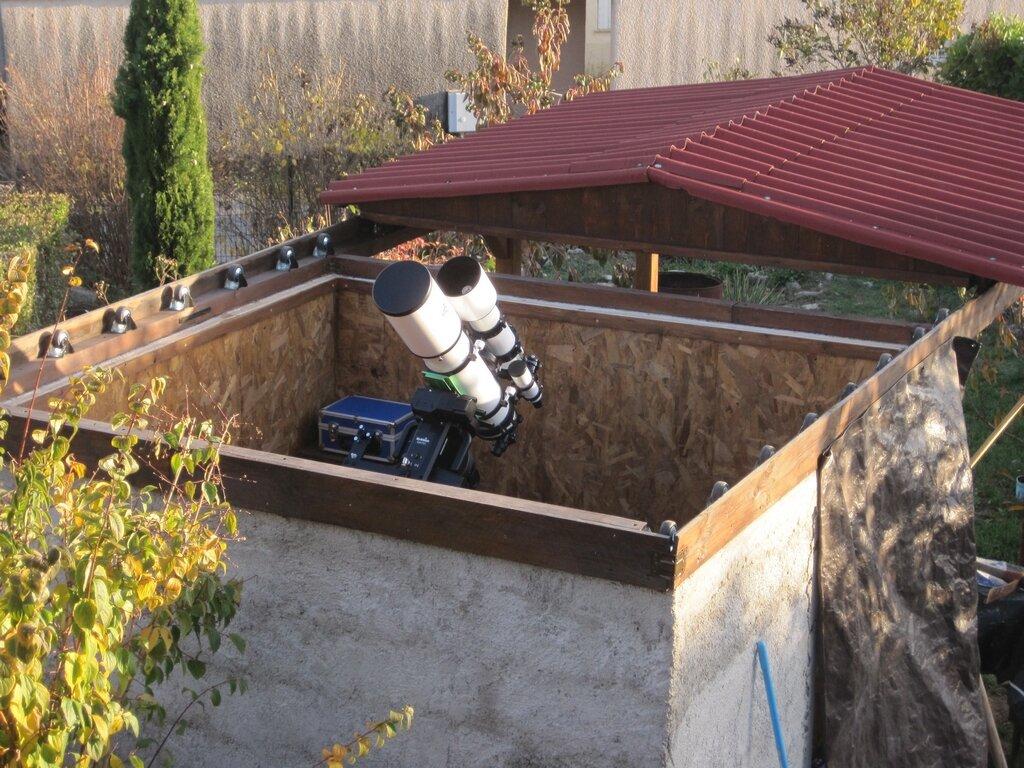

One of the most feared risks in a roll-off roof observatory is a collision between the roof and the telescope.
A handling error, software issue, or hardware failure can potentially cause significant damage to the optical tube, the mount, and the roll-off roof mechanism.
To avoid this scenario, two approaches are generally used by amateur astronomers:
- Verifying the mount’s “Park” position via the ASCOM driver;
- Using a sensor or mechanical limit switch to physically validate the telescope’s position.
So, which solution offers the best level of security?
Are you automating your observatory?
The safety of your roll-off roof is an essential part of observatory automation.
Aurora 2.0 allows you to control your roll-off roof while integrating the safety conditions required for its operation.
Understanding the Problem
Before a roll-off roof can move, one must ensure that the telescope is oriented to provide sufficient clearance.
In most amateur observatories, this corresponds to a predefined parking position of the mount. If the roof opens or closes while the telescope is still in its observation position, a collision can occur.
The question is therefore simple: How can you verify with certainty that the telescope is actually in its safe position?
Solution #1: Verifying the Parked Telescope via the Mount Driver
This method consists of directly querying the mount’s ASCOM driver. When the mount reaches its parking position, it reports its “Parked” status to the observatory control software. The roof controller can then authorize or prohibit roof movement based on this information.
Advantages
- Native integration with automation: Most modern ASCOM-compatible mounts handle parking functions natively. No extra sensors are needed.
- Simplified installation: No specific wiring is required between the telescope and the observatory structure. Security relies on information already provided by the mount.
- Ideal compatibility with automated observatories: In a remotely operated observatory, the controller can automatically verify:
- Park status;
- Tracking status;
- Mount connection.
- This makes it easy to integrate safety into automated sequences.
- A clean, scalable solution: Adding or replacing a mount generally requires no mechanical modifications to the observatory.
Limits of Driver-Based Security
This method relies on an important assumption: the driver correctly indicates the mount’s actual position.
In the vast majority of cases, this assumption is valid. However, exceptional situations can arise:
- Software error;
- Firmware bug;
- Driver malfunction;
- Incorrect parking position configuration.
In these very specific cases, the “Parked” status could theoretically no longer reflect the telescope’s exact physical position.
Solution #2: Validation via Mechanical Limit Switch
This approach involves installing a sensor or a mechanical switch directly on the mount or a moving part of the system. The roof is only allowed to move when this sensor is triggered. In other words, the controller no longer checks what the mount claims, but what it physically verifies.
The Advantages
- A real physical measurement: The main advantage is obvious: the sensor detects a physical position, not just software data. For some users, this provides an extra layer of confidence.
- Independence from software: Even if the PC crashes or a driver encounters an issue, the sensor continues to function.
- Easy-to-understand logic: If the contact is not activated, the roof remains locked. This simplicity appeals to many DIY observatory builders.
The Limits of a Mechanical Limit Switch
Contrary to what one might think, a mechanical limit switch is not infallible.
- Possible mechanical wear: Like any mechanical component, it can become misaligned, wear out, break, or be affected by humidity and corrosion.
- Sometimes too precise: The sensor must be correctly adjusted. A slight shift in the mount, a configuration change, or the addition of a new instrument may require repositioning the system.
- More complex installation: This solution generally involves additional wiring, mechanical supports, adjustments, and periodic testing.
- A false sense of security: A sensor might confirm that a part of the mount is in the right place without guaranteeing that the entire telescope is actually out of the roof’s path. This becomes particularly true as instrumentation evolves over time.
Quick Comparison
| Criteria | ASCOM Park Status | Mechanical Limit Switch |
| Installation | Very simple | More complex |
| Additional wiring | None | Necessary |
| Maintenance | Very low | Periodic |
| Physical detection | No | Yes |
| Automation compatibility | Excellent | Good |
| Scalability | Excellent | Variable |
| Risk of mechanical failure | None | Present |
Which solution to choose?
For the majority of modern amateur observatories, verifying the Park status provided by the mount is a reliable, easy-to-implement solution that is perfectly adapted to automation. It is the approach adopted by many observatory control software systems.
However, the mechanical limit switch remains an interesting alternative for users wishing to have physical validation independent of the computer system.
Ready to Automate Your Observatory?
Aurora 2.0 lets you centralize control of your roll-off roof and seamlessly integrate it into your observatory setup.
The Best Approach: Redundancy
In critical systems, the question is often not which solution is the best, but how to prevent a single point of failure from causing an accident.
This is why some advanced observatories use dual validation:
- Verification of the Park status provided by the mount;
- Supplementary physical validation via a sensor or limit switch.
This approach combines the advantages of both technologies and further increases the overall level of security.
Ultimately, the security of a roll-off roof observatory does not depend solely on a sensor or software. It relies first and foremost on a consistent design of the entire system, regular testing, and a strategy adapted to the desired level of automation.
AmateurAstronomy #Astrophotography #AutomatedObservatory #RollOffRoof #ASCOM #NINA #ObservatorySafety #RemoteObservatory #DeepSky #Astrophoto #Telescope #EquatorialMount #AstronomyGear #ObservatoryAutomation #AstronomySafety