🔧 Observatory Roof Motorization: Choosing the Right Mechanical System (Complete Aurora 2.0 Guide)
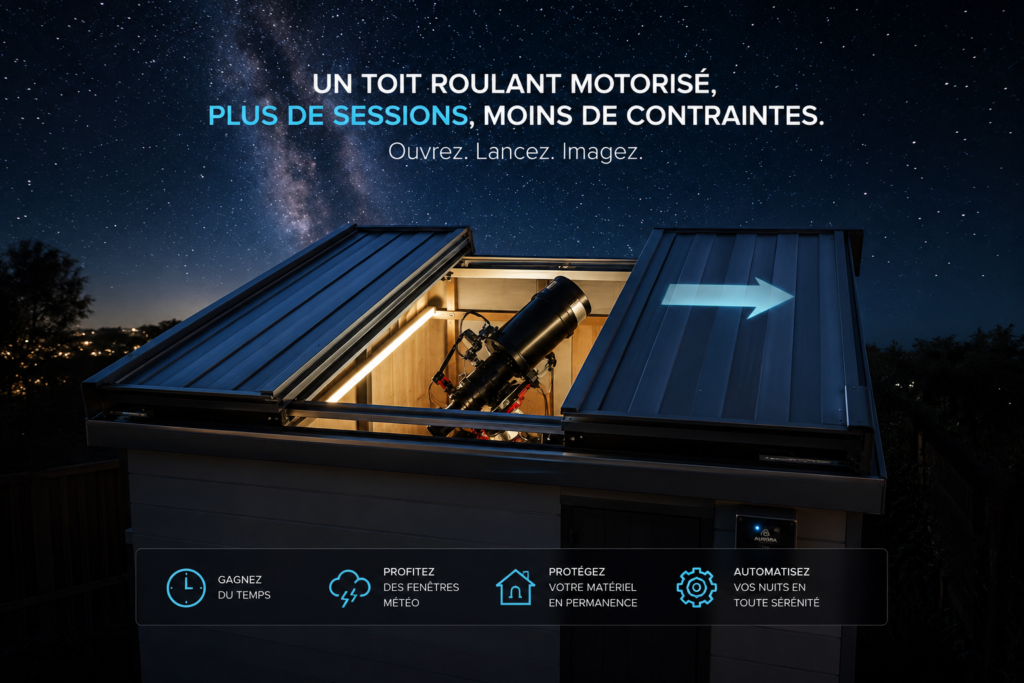
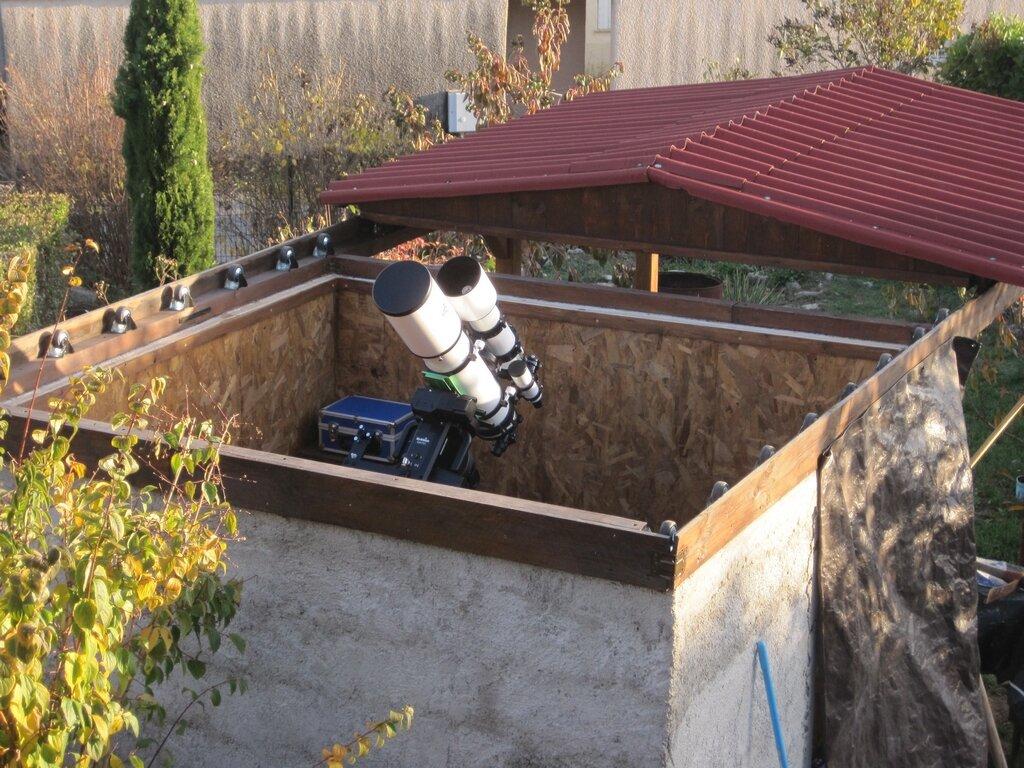
Transforming a simple garden shed into a fully automated astronomical observatory relies on one critical mechanical step: motorizing the roll-off roof.
This is what determines the reliability of your setup, the safety of your optical equipment, and the precision of remote operation. A poor mechanical choice does not simply result in a stuck roof; it can lead to excessive current draw, structural damage, or the inability to close the observatory quickly when a storm approaches.
This technical guide provides the physical principles needed to properly size your installation and compare the two most reliable and practical DIY solutions available today, both fully compatible with the Aurora 2.0 control ecosystem.
1. Roof Physics: Understanding the Forces Involved
Before ordering a motor, it is important to eliminate a common misconception: the motor does not have to lift the weight of the roof (vertical load). Instead, it must overcome horizontal friction forces and dynamic loads.
A. Linear Friction Force
This force depends on the total roof weight and the friction coefficient of your rolling system.
Simplified formula:
Friction Force = Roof Mass (kg) × 9.81 × Friction Coefficient
Typical friction coefficients observed in the field:
- Steel rollers on precision V-groove steel rails (Recommended): coefficient between 0.03 and 0.05
- Nylon wheels or rollers on flat rails: coefficient between 0.10 and 0.15
- Wood-on-wood friction or dirty rails: coefficient greater than 0.30 (Strongly discouraged)
B. Dynamic Loads (Wind and Snow)
Wind applies both a horizontal drag force on the roof edge and an uplift force. In addition, snow accumulation can double the weight of your structure during winter.
Your motor should therefore be oversized using a safety factor of at least 2 to account for adverse weather conditions combined with mechanical resistance.
📐 Practical Example
For a 3 × 3 m observatory roof weighing 250 kg and equipped with steel rollers on V-groove rails (coefficient 0.05):
Friction Force = 250 × 9.81 × 0.05 = 122.6 Newtons
Applying a safety factor of 2:
Your system should be capable of delivering a continuous horizontal thrust force of at least 250 Newtons.
2. The Two Practical Solutions Used in the Field
For an observatory roll-off roof, the required travel distance corresponds directly to the roof opening width, typically between 2 and 3.5 meters.
Two adapted industrial motor systems provide the bidirectional drive capability (active push and pull) required.
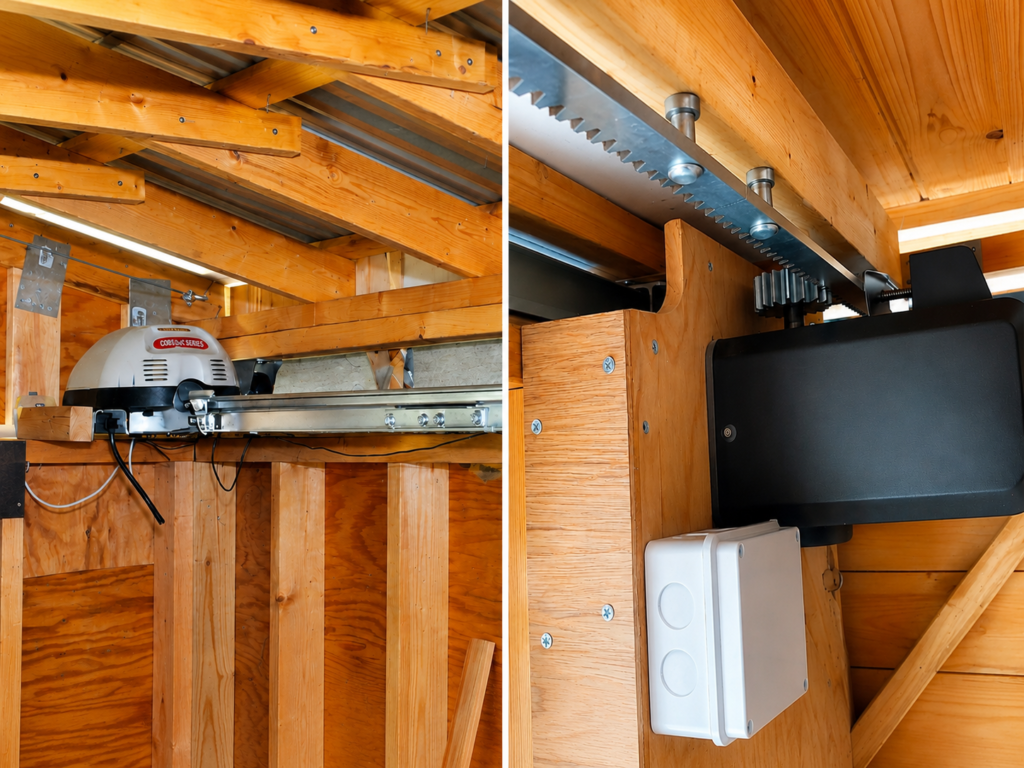
🟢 Solution A: Rack-and-Pinion Gear Motor (Sliding Gate Opener)
The motor is mounted on top of one observatory wall (or on an external extension post) and drives a pinion gear that engages a rack installed along the entire roof edge.
Advantages
- Virtually unlimited travel length by adding additional rack sections
- Constant movement speed
- Excellent wind resistance thanks to the worm-gear reduction system
- Mechanical locking of the roof when closed
Disadvantages
- Requires very precise alignment
- A constant gear mesh clearance of approximately 1–2 mm must be maintained along the entire rack length
- Poor alignment can cause binding or gear skipping
🔵 Solution B: Garage Door Opener (Chain or Belt Drive Rail System)
This solution is particularly elegant, clean, and highly popular among amateur astronomers.
The system consists of a fixed motor head connected to a long straight tubular rail. Inside the rail, a reinforced chain or toothed belt runs in a closed loop. A carriage attached to the observatory roof travels along the rail to open or close the structure.
Advantages
- Designed from the factory for both active pulling and pushing
- Excellent closing safety
- The rail protects the chain or belt from dust, rust, and debris
- Very forgiving and easy to install
- The rail serves as a perfectly aligned guide system
Disadvantages
- Maximum travel is limited by the factory rail length
- Typical rail lengths range from 3 to 4 meters
- Suitable for most observatories up to approximately 3 × 3 m or 3.5 × 3.5 m
- Larger observatories require careful rail length verification before purchase
3. Control Interface & Aurora 2.0 Integration
The Aurora 2.0 controller from AstroRemote Systems centralizes observatory safety management.
For a motor to be compatible, its control electronics must interface with the Aurora output relays (dry contacts).
Dry Contact Pulse Logic
This is the standard used by nearly all modern gate and garage door motors.
Their control boards typically provide low-voltage inputs labeled:
- Push Button
- Step-by-Step
- Open / Close
- Open / Stop / Close
A relay closure from Aurora 2.0 simulates a wall-mounted push-button command.
Compatibility is native and complete.
Polarity Reversal (Raw DC Motors)
With bare 12V or 24V DC motors that have no integrated control electronics, direction changes are achieved by reversing positive and negative polarity.
Not compatible with Aurora 2.0.
⚠️ Essential Mechanical Safety Requirements
Automation removes direct human intervention. Therefore, the system must be capable of stopping automatically if a problem occurs.
Limit Switches
Whether electronic (programmed travel limits in garage door systems) or physical (magnetic sensors), limit switches must stop the motor when the roof reaches its fully open or fully closed position.
Current-Sensing Obstacle Detection
Most modern garage door and sliding gate motors include this safety feature.
If the roof encounters abnormal resistance—such as a forgotten tool, ice buildup on the rail, or an improperly parked telescope—the motor detects the current spike, stops immediately, and reverses direction to minimize damage.
Ready to Automate Your Observatory?
Aurora 2.0 lets you centralize control of your roll-off roof and seamlessly integrate it into your observatory setup.
4. Community-Proven Motor Models
Rack-and-Pinion Systems (Sliding Gates)
Nice Robus (400 or 600)
24V DC motor with advanced speed management, including progressive acceleration and deceleration ramps that reduce mechanical stress on the observatory structure.
BFT Deimos Ultra BT A400
24V model equipped with magnetic limit switches.
Unlike mechanical levers, magnetic sensors are unaffected by freezing temperatures or frost accumulation.
Tubular Rail Systems (Garage Doors)
Hörmann SupraMatic and ProMatic Series
Widely regarded as industry benchmarks for reliability.
Their control boards include external push-button inputs that are extremely easy to connect to Aurora 2.0 relays.
They use reinforced Kevlar timing belts that are exceptionally quiet and require no maintenance.
Somfy Dexxo Optimo and Pro
Robust 24V motors featuring highly sensitive current-based obstacle detection and extremely precise electronic travel limit adjustments.
5. Project Sizing Checklist
☐ Mass Calculation: Include the wooden structure, roofing material (steel sheets, shingles, etc.), and an additional safety margin for winter conditions such as snow accumulation and wind loading.
☐ Travel Verification: If choosing a garage door opener system, carefully measure the required roof opening width and verify that the available rail length allows complete roof travel.
☐ Backup Power Supply: Favor 24V DC motors whenever possible. They allow the installation of a backup battery inside the observatory. In the event of a power outage—common during storms—Aurora 2.0 and your UPS-powered computer can still issue a priority close command, while the motor uses its backup battery to safely protect your telescope.
Subscribe to our newsletter
Get early access to our latest articles, practical tips for your astronomical observatory, and exclusive offers.