When you invest in astrophotography gear, one question quickly becomes essential: how do you protect your telescope for the long term? Because beyond optical performance, the real daily challenge is often very concrete: preserving your equipment over time. This is exactly where a motorized roll-off roof comes into play for amateur astronomy observatories.
Why Telescope Protection is a Major Challenge in Astrophotography
An astrophotography setup often represents:
- Several years of financial investment;
- Highly sensitive equipment;
- Precision optics;
- Fragile electronics.
Unlike occasional use, many amateur astronomers now leave their equipment set up for long periods. This raises a simple question: how can you effectively protect this setup between imaging sessions?
The Main Role of a Motorized Roll-Off Roof in an Amateur Observatory
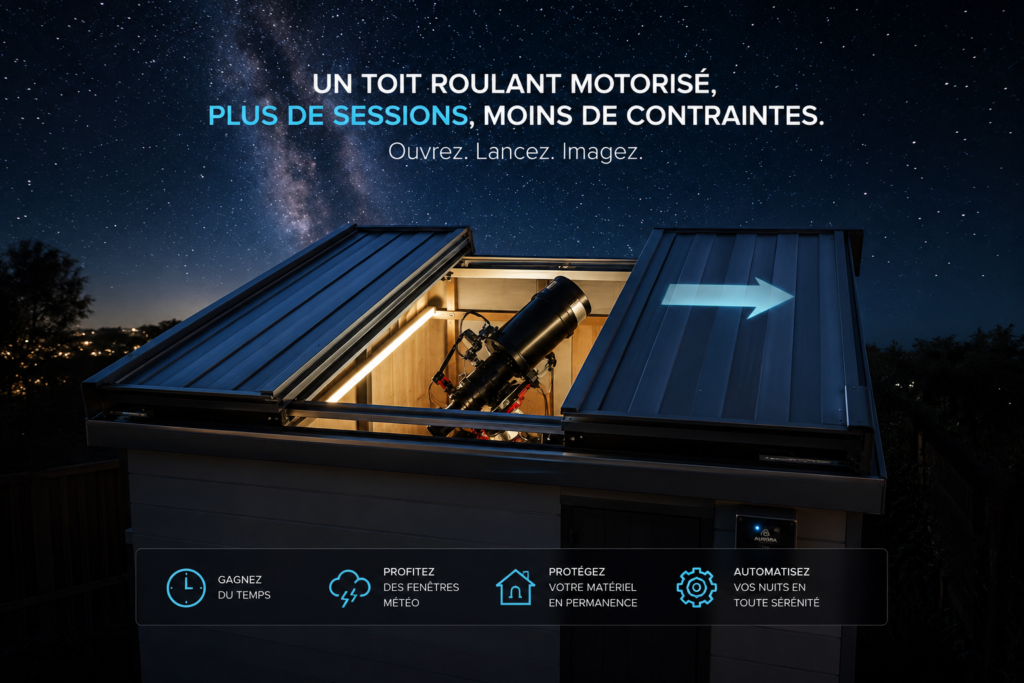
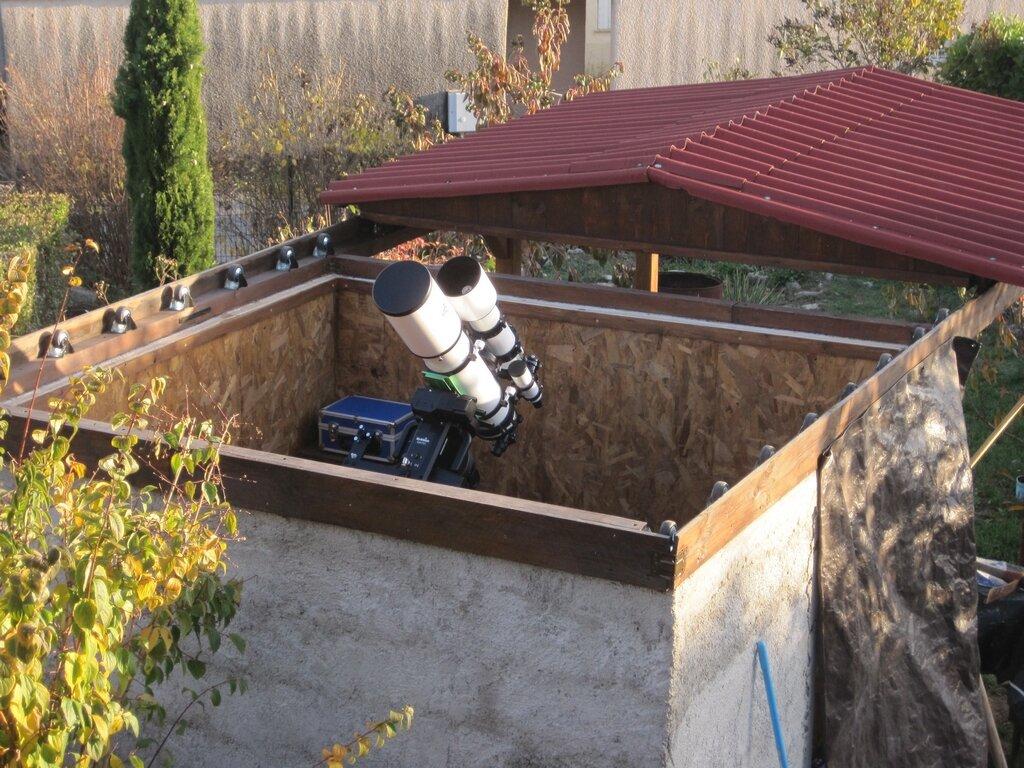
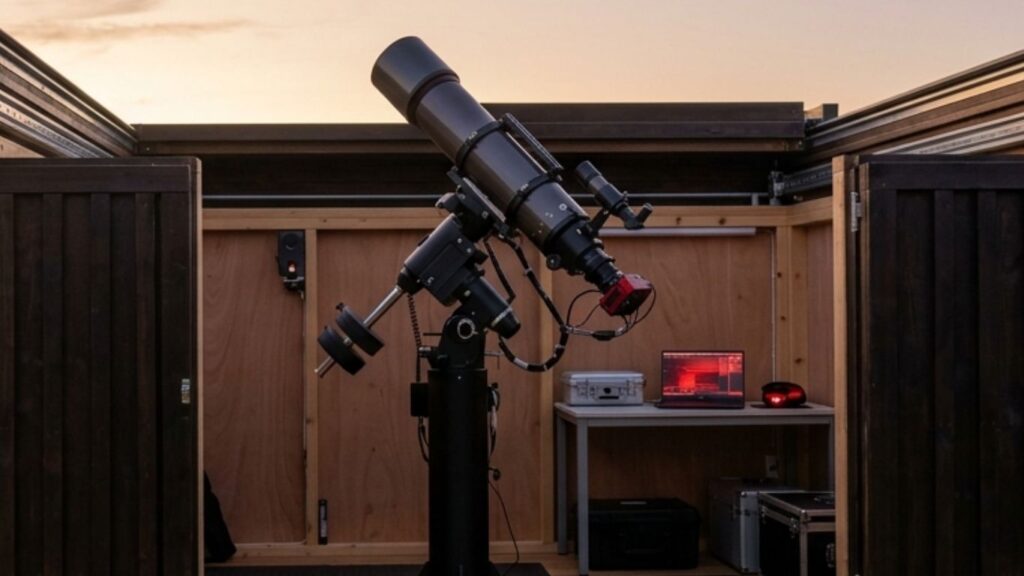
A motorized roll-off roof plays a fundamental role: it protects the equipment when not in use while keeping the setup completely ready for imaging. Concretely:
- The telescope remains fully assembled;
- The mount stays perfectly aligned with Polaris (the North Star);
- The cables remain connected and in place;
- The system is simply covered or uncovered depending on your needs.
This setup eliminates the need to tear down and rebuild everything for every single session. And that completely changes the user experience.
Passive Protection vs. Automation: What You Really Need to Understand
There is often confusion when planning an amateur astronomy observatory project. Some imagine highly complex, fully automated systems. In reality, many setups operate very simply. An observatory roll-off roof can be:
- Manual;
- Semi-assisted;
- Motorized for added comfort.
The essential point is not necessarily the level of automation. The core goal is ensuring reliable equipment protection when the setup is idle.
Want to go beyond simple motorization?
A motorized roll-off roof already helps protect your equipment and makes your observatory easier to use.
With Aurora 2.0, you can take it a step further by integrating your roll-off roof into a complete observatory automation system.
👉 Discover Aurora 2.0, the smart controller for your roll-off roof
Mechanical Security and Surveillance: A Must-Have Combo
Weatherproofing is one thing, but security against intrusions is another. An amateur observatory holds significant financial and sentimental value, making access locking crucial.
Mechanical Security First
When the roll-off roof is closed, it must benefit from robust mechanical security (heavy-duty padlocks, storm hooks, or physical motor locking mechanisms). The goal is simple: prevent any forced opening from the outside and withstand violent winds.
Smart Security as a Complement
Beyond this mechanical shielding, amateur astronomers frequently equip their observatories with electronic protections:
- A surveillance camera: Pointed inward (to verify that the roof does not jam the telescope) and sometimes outward (to monitor the surroundings).
- An alarm system: A small motion detector alarm or door/roof opening sensors allow you to be alerted instantly in case of an intrusion attempt.
Why a Fixed Setup Reduces Daily Risks
One of the greatest advantages of a permanent astrophotography setup is the drastic reduction in equipment handling. Every time you disassemble and reassemble a telescope:
- There is a risk of optical misalignment (collimation issues);
- Cables can wear out or accidentally disconnect;
- Polar alignment must be redone from scratch;
- The mount’s precision mechanics (especially the worm gears) risk being damaged;
- The equipment is physically manipulated and exposed to drops.
With an amateur astronomy observatory equipped with a motorized roll-off roof:
- The equipment stays in place;
- All settings and alignments are preserved;
- Physical handling is minimized.
The result: fewer errors, less wear and tear, and maximum stability.
A Simple Solution to Secure Your Gear Without Useless Complexity
For most amateurs, simplicity is key. An observatory does not need to become an overly complex engineering project. In most cases, the objective is simply to:
- Protect the gear;
- Provide easy access to the telescope;
- Make imaging sessions more frequent;
- Avoid repetitive setups.
And that is precisely what a well-designed motorized roll-off roof delivers to an amateur observatory. You don’t need over-engineered systems to get a real daily benefit.
FAQ: Motorized Roll-Off Roof and Telescope Protection
Is a motorized roll-off roof enough to protect a telescope?
Yes, it effectively protects your gear from harsh weather when not in use. For overall security, it is generally combined with a strong physical mechanical locking system.
How do I secure my observatory against theft?
In addition to solid mechanical locks on the roof and door, amateur observatories often feature a connected security camera and sometimes a small alarm system to detect any unauthorized entry.
Does an observatory need to be fully automated?
While full automation is often the ultimate goal for amateur astrophotographers, many setups work beautifully with a simple motorization setup combined with manual or semi-automated control.
Why should I use a permanent fixed observatory?
Mainly to avoid repetitive equipment handling and to perfectly preserve your astrophotography setup’s alignments and calibrations.
🔭 Are you building or automating your observatory?
Receive our upcoming tips on roll-off roofs, motorization, safety, and automation for amateur astronomical observatories.
Practical advice to help you build a reliable, easy-to-use observatory ready for remote astrophotography.
👉 Receive our latest articles directly by email