When discovering automated astronomical observatories, one question almost always comes up:
👉 “But concretely… how does a roll-off roof actually work?”
Many people imagine a complex system, reserved for engineers or professional observatories.
In reality, the principle is often much simpler than expected.
And it is precisely this simplicity that explains why the astronomical roll-off roof has become the preferred solution for many amateur astronomers.
Reliable, accessible, and relatively easy to automate, it completely transforms the home astronomy experience.
What is an astronomical roll-off roof?
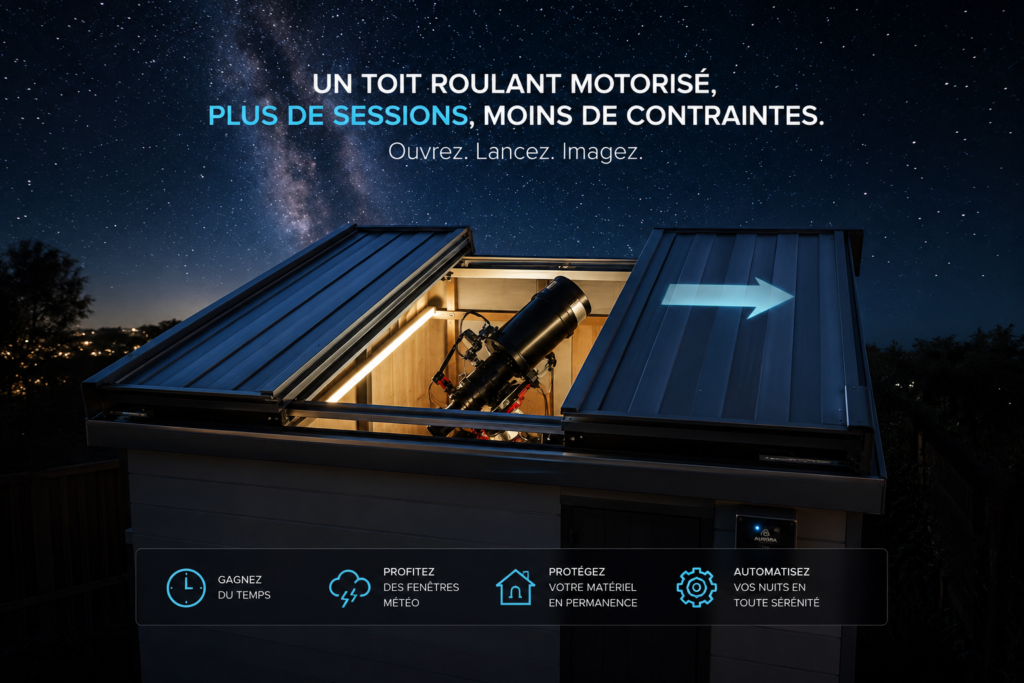
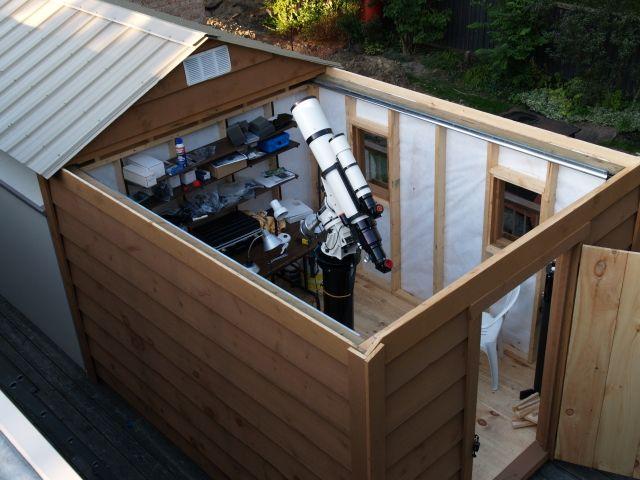
A roll-off roof is a system that allows the entire roof of an observatory to slide open, revealing the sky above the telescope.
The principle is simple:
- the building remains fixed
- the roof slides on rails
- the instrument stays permanently installed
It is often referred to as:
- roll-off roof observatory
- roll-off roof observatory shed
- automated astronomical observatory
Unlike a classic dome observatory, a roll-off roof offers a solution that is:
✅ simpler
✅ more affordable
✅ easier to build
✅ and often easier to automate
Why amateur astronomers love this system
The main advantage is obvious:
👉 the equipment is always ready.
No need to:
- set up the telescope
- redo polar alignment
- reconnect all cables
- waste time before each session
In practice, this changes everything.
Even a short weather window can be used immediately.
And in regions where clear nights are rare, this becomes a huge comfort.
How does a roll-off roof work mechanically?
The mechanical operation is generally based on four main elements:
1. Rails
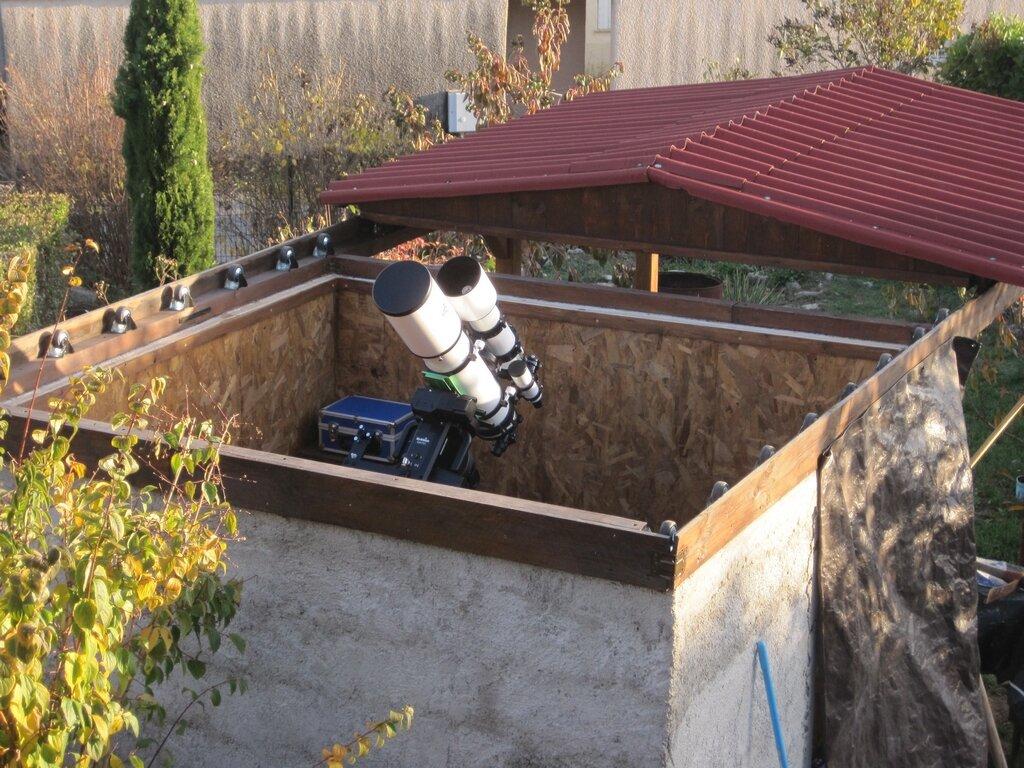
The roof moves along rails fixed to the structure.
In many amateur builds, people use:
- metal rails
- reinforced profiles
- systems inspired by industrial doors
Mechanical simplicity is often preferred to ensure long-term reliability.
2. Rollers
The roof rests on heavy-duty rollers designed to support the weight of the structure.
The goal:
- ensure smooth movement
- avoid jams
- reduce wear
Proper rail alignment is essential.
3. Motor
The motor allows the roof to open and close automatically.
Depending on the project, it can be:
- a gate motor
- an industrial motor
- an actuator
- or a system adapted to roof size
Contrary to what many imagine, extremely powerful motors are not required for a well-designed amateur observatory.
4. Automation controller
This is the “brain” of the system.
The controller manages:
- opening
- closing
- safety systems
- sensors
- and sometimes communication with astronomy software
It is what makes the roll-off roof automated and safe.
The role of safety sensors
Safety is a key aspect of an automated observatory.
Most systems use sensors to detect:
- whether the roof is fully open
- fully closed
- or in motion
These protections help avoid:
- positioning errors
- mechanical jams
- dangerous movements
Can a roll-off roof be automated easily today?
Yes — much more easily than before.
For a long time, automating an observatory required:
- custom programming
- building electronics from scratch
- assembling complex systems
Today, much more accessible solutions exist.
Modern controllers now simplify installation and operation significantly.
👉 This is precisely the goal of solutions like
AURORA 2.0 by Astro Remote Systems
which are designed to make automation more accessible for amateur astronomers who want to secure and simplify their observatory.
Why roll-off roofs are often preferred over domes
Astronomical domes are impressive…
But in practice, many amateurs eventually choose a roll-off roof.
Why?
Because it often offers:
- less mechanical complexity
- less maintenance
- simpler construction
- more reasonable cost
- easier automation
For a backyard observatory, a roll-off roof is often the best compromise between comfort and simplicity.
Common mistakes when building a roll-off roof
Trying to make the system too complex
Many beginners think everything must be automated from the start.
In reality:
👉 a simple and reliable system is often better.
Underestimating rail quality
Poor alignment can cause:
- jams
- wear
- opening issues
Mechanical precision is essential.
Neglecting safety systems
Even in amateur setups, sensors and safety mechanisms are important to protect equipment.
Is an automated observatory accessible to amateurs?
Yes.
This is one of the most important evolutions in amateur astronomy in recent years.
Today:
- information is widely available
- communities share knowledge
- motors are affordable
- plug-and-play systems simplify automation
Result:
👉 more and more enthusiasts are building their own observatories at home.
And contrary to popular belief, many are neither engineers nor electronics experts.
What an automated observatory really changes
Once the equipment is permanently installed:
- you observe more often
- you waste less time
- you take better advantage of clear nights
- astronomy becomes more comfortable
For many amateurs, it is a real lifestyle change in their passion.
🔭 A solution for automating your roll-off roof
Solutions like Aurora 2.0 allow you to automate the control of your observatory’s roll-off roof and integrate it into an ASCOM-compatible astronomy environment.
The goal is simple: open, close, and manage your roll-off roof more easily, while incorporating the necessary safety conditions for its operation.
Conclusion
The operation of a roll-off roof observatory is ultimately based on a simple idea:
👉 move a roof reliably and safely to fully reveal the sky above the telescope.
Thanks to modern systems:
- mechanics are more accessible
- automation is simpler
- plug-and-play solutions now allow many amateurs to build their own observatories
What once seemed reserved for professional facilities is now a realistic solution for a growing number of amateur astronomers.
Subscribe to our newsletter
Get early access to our latest articles, practical tips for your astronomical observatory, and exclusive offers.
FAQ – Astronomical roll-off roof observatory
What motor should be used for a roll-off roof?
Many amateurs use gate motors or systems adapted to roof size and weight.
Can a roll-off roof be automated without programming?
Yes. Modern solutions now allow a much simpler approach.
What is the difference between a dome and a roll-off roof?
A dome rotates around the telescope, while a roll-off roof slides completely away to expose the sky.
Why choose a roll-off roof for an amateur observatory?
Because it is generally:
- simpler
- more affordable
- easier to build
- easier to automate