Roll-Off Roof vs Dome Observatory: Which Is Best for Amateur Astronomy?
When planning an amateur astronomy observatory, one question almost always comes up:
Should you choose a motorized roll-off roof observatory or a traditional astronomical dome?
For decades, the dome has been the iconic symbol of astronomy.
It immediately brings to mind:
- Large professional observatories
- Famous observatory domes
- Spectacular research facilities featured in documentaries and magazines
However, among modern amateur astronomers and astrophotographers, a growing number of enthusiasts are choosing a different solution:
👉 The motorized roll-off roof observatory.
Why is this trend growing? What are the advantages of each system? And which option is best suited to your project?
Why This Debate Matters in Amateur Astronomy
Both systems share the same objective:
Protect permanently installed astronomical equipment while providing optimal conditions for observing and astrophotography.
However, they operate very differently.
How a Dome Observatory Works
A dome observatory relies on:
- Dome rotation
- An adjustable observing slit
- A limited viewing window into the sky
The telescope can only observe through the opening aligned with the target.
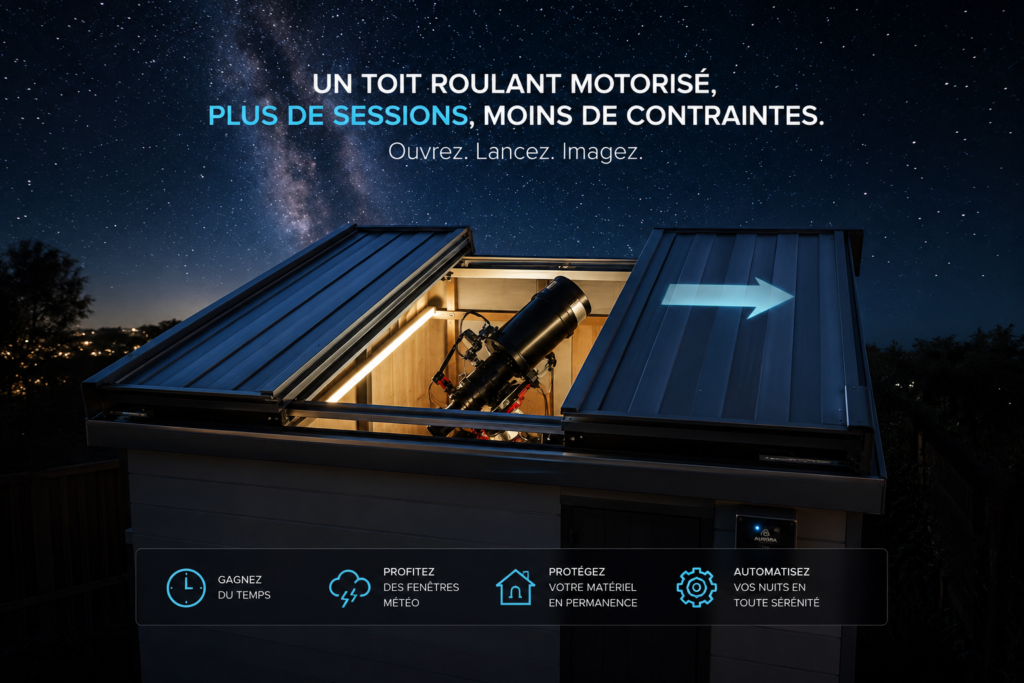
How a Roll-Off Roof Observatory Works
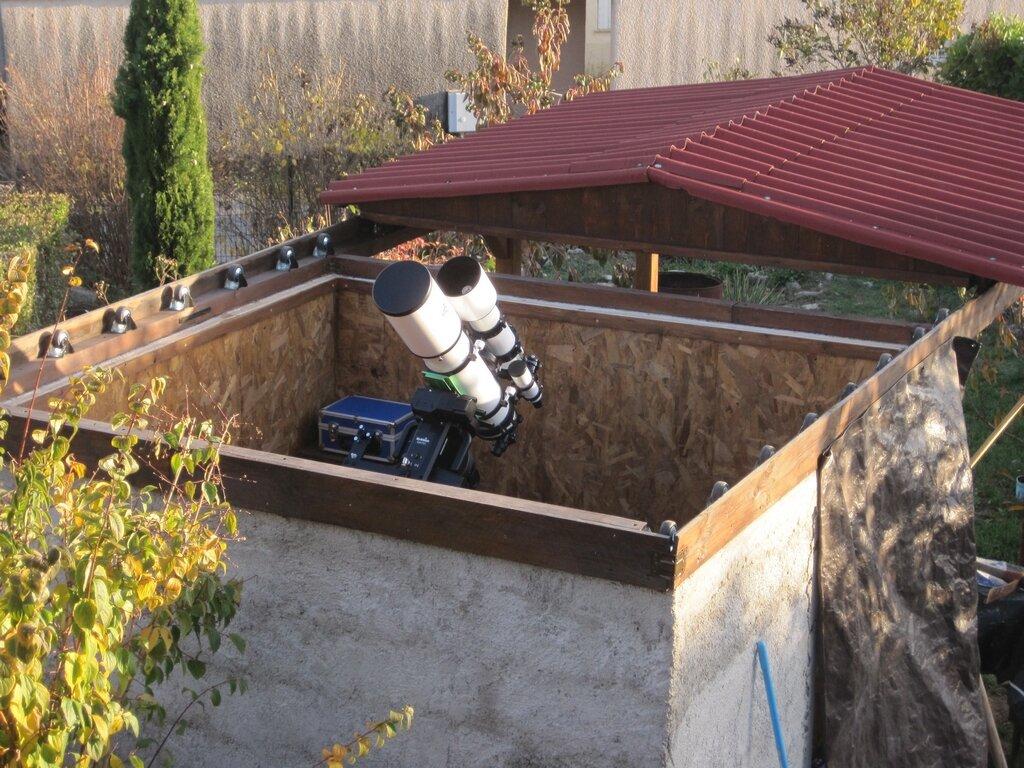
A roll-off roof observatory functions differently.
Once the roof is opened, the entire sky becomes visible.
The telescope gains unrestricted access to the celestial sphere without any viewing slit limitations.
This difference significantly impacts daily operation and user experience.
Advantages of a Motorized Roll-Off Roof Observatory
Today, many amateur astrophotographers favor roll-off roof observatories because of their simplicity and efficiency.
The concept is straightforward:
- The roof slides open
- The sky is fully exposed
- The equipment is instantly ready for use
This approach offers several important advantages.
Simpler Mechanical Design
A motorized roll-off roof usually contains fewer moving parts than a rotating dome.
This often simplifies:
- Design
- Construction
- Maintenance
- Motorization
- Automation
For many amateur astronomers, fewer mechanical components mean fewer potential failures and easier future upgrades.
Complete Access to the Sky
One of the biggest advantages of a roll-off roof observatory is unrestricted sky access.
Once opened, the telescope can freely point anywhere without repositioning a dome slit.
This greatly benefits:
- Long imaging sessions
- Automated target tracking
- Multi-target acquisition sequences
- Remote operation
The telescope never loses visibility because of dome positioning.
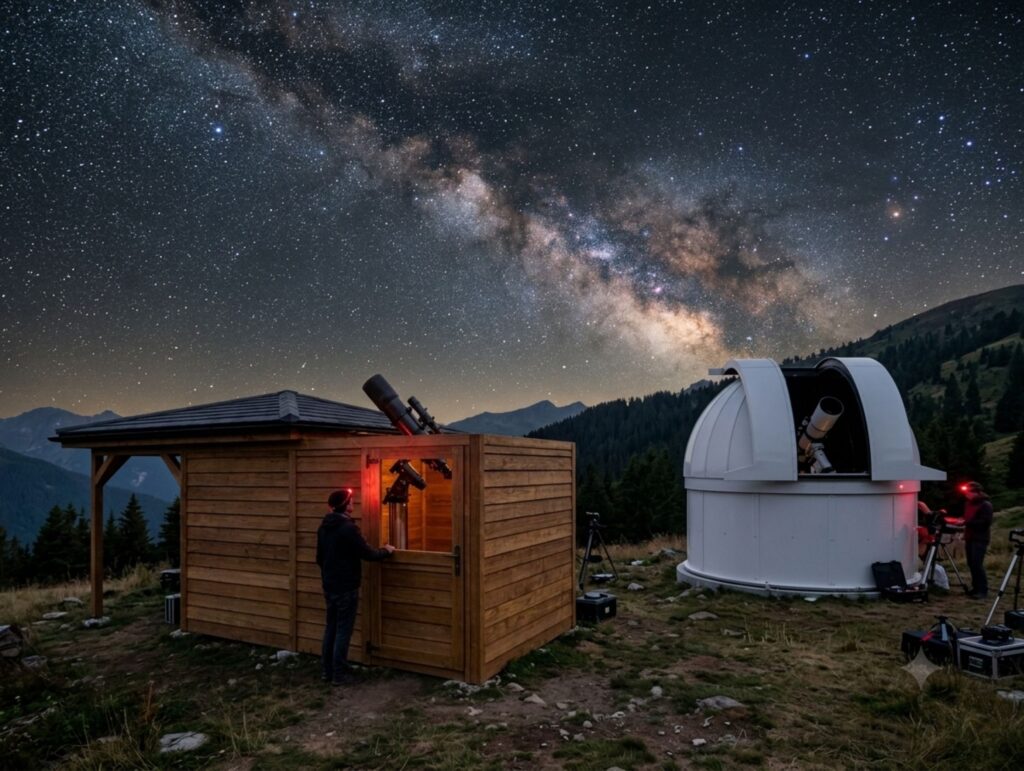
A More Immersive Astronomy Experience
This advantage is frequently mentioned by amateur astronomers.
With a fully open observatory, observers maintain a direct connection with the night sky.
They can fully enjoy:
- The Milky Way
- Constellations
- Meteor showers
- Celestial events
- The atmosphere of the night sky
Many users find this experience more enjoyable than operating from inside a partially enclosed dome.
Better Discretion and Security
This is a major advantage that is often overlooked.
A roll-off roof observatory typically resembles an ordinary garden shed when closed.
As a result, it blends naturally into its surroundings and attracts little attention.
Most people would never suspect that expensive astronomical equipment is stored inside.
This provides several benefits:
- Better garden integration
- Reduced visual impact
- Less curiosity from neighbors or passersby
- Lower risk of theft or vandalism
By comparison, an astronomical dome is instantly recognizable.
Even people unfamiliar with astronomy quickly understand that it likely contains valuable equipment.
For many observatory owners, this security aspect becomes a decisive factor.
🚀 Have you chosen a roll-off roof? Take the next step toward automation.
A motorized roll-off roof already offers simplicity, accessibility, and a completely unobstructed view of the sky.
With Aurora 2.0, you can take it a step further by automating your roll-off roof and integrating its control into your observatory.
👉 Discover Aurora 2.0, the smart controller for your roll-off roof
Limitations of Dome Observatories
Astronomical domes remain excellent solutions in many situations.
They provide enhanced protection against:
- Wind
- Side moisture
- Certain atmospheric disturbances
- Nearby light sources
However, they also introduce additional technical complexity.
Typical challenges include:
- Dome rotation synchronization
- Continuous slit alignment
- More advanced automation systems
- Additional mechanical maintenance
For some amateur observatories, these constraints can outweigh the benefits.
Why Modern Astrophotographers Prefer Open-Sky Setups
Modern astrophotography increasingly relies on automation.
Most users prioritize:
- Simplicity
- Reliability
- Fast deployment
- Ease of use
Roll-off roof observatories align perfectly with these objectives.
The equipment remains permanently installed.
Polar alignment is preserved.
The observatory is ready whenever clear skies appear.
As a result:
- Weather windows are used more efficiently
- Short clear nights become productive
- Imaging sessions occur more frequently
- Setup and teardown time is eliminated
Experienced astrophotographers often say:
The best observatory is the one you use most often.
Supporting Multiple Telescopes Simultaneously
Another major advantage of a roll-off roof design is scalability.
In a dome observatory, the observing slit generally limits operations to a single telescope aligned with the opening.
Running multiple instruments pointed at different areas of the sky can quickly become complicated.
With a roll-off roof observatory, the entire sky remains accessible.
This makes it possible to operate multiple systems simultaneously, such as:
- A deep-sky imaging telescope
- A wide-field refractor
- A solar telescope
- A visual observing setup
Each instrument can independently target different celestial objects.
Benefits include:
- Imaging multiple targets at the same time
- Increased observatory productivity
- Better use of clear nights
- Progressive expansion of the observatory
For advanced astrophotographers and fully automated observatories, this advantage is often a key decision factor.
🔭 Planning your future observatory?
Receive our upcoming tips on roll-off roofs, motorization, automation, and remote astrophotography.
Practical advice to help you design a simple, reliable, and scalable observatory.
👉 Receive our latest articles directly by email
Which Observatory Type Should You Choose?
There is no universal answer.
The best choice depends on:
- Budget
- Local climate
- Available space
- Environmental conditions
- Desired automation level
- Astronomy goals
Dome observatories remain highly valuable in specific situations where wind protection and environmental shielding are priorities.
However, motorized roll-off roof observatories continue to gain popularity thanks to their balance of:
- Simplicity
- Efficiency
- Security
- Automation
- Expandability
- Cost-effectiveness
For many amateur astronomers, they represent the most practical solution for modern astrophotography.
Frequently Asked Questions
Is a Roll-Off Roof Observatory Simpler Than a Dome?
In most cases, yes. Roll-off roofs generally require less complex mechanics and simpler automation systems.
Why Do Astrophotographers Prefer Open-Sky Observatories?
Because they provide unrestricted access to the sky and simplify long automated imaging sessions.
Does a Dome Offer Better Protection?
Yes. Domes can provide superior protection against wind and certain environmental conditions.
Is a Roll-Off Roof Observatory More Discreet?
Absolutely. When closed, it often resembles a standard garden shed and attracts significantly less attention than an astronomical dome.
Can Multiple Telescopes Be Used in a Roll-Off Roof Observatory?
Yes. This is one of its greatest advantages. Multiple instruments can operate simultaneously on different targets, which is much more difficult inside a traditional dome observatory.
Final Thoughts
Both dome observatories and roll-off roof observatories have their strengths.
However, the growing popularity of automated astrophotography and remote observatory control has made roll-off roof designs increasingly attractive.
Their simplicity, flexibility, lower maintenance requirements, and ability to support multiple instruments make them one of the most practical solutions available to amateur astronomers in 2026.
🚀 Have you chosen a roll-off roof?
A motorized roll-off roof offers an excellent balance of simplicity, accessibility, and scalability.
To take it a step further and turn your observatory into an automated setup, Aurora 2.0 allows you to control your roll-off roof and integrate its operation into your astronomy system.
👉 Discover Aurora 2.0 and automate your roll-off roof
RollOffRoofObservatory #DomeObservatory #AmateurAstronomy #Astrophotography #BackyardObservatory #ObservatoryAutomation #DIYObservatory #RemoteObservatory #AstronomyEquipment #AstronomyLife #TelescopeSetup #ObservatoryDesign #AstronomyDIY #DeepSkyImaging #Astrophotographer