Introduction
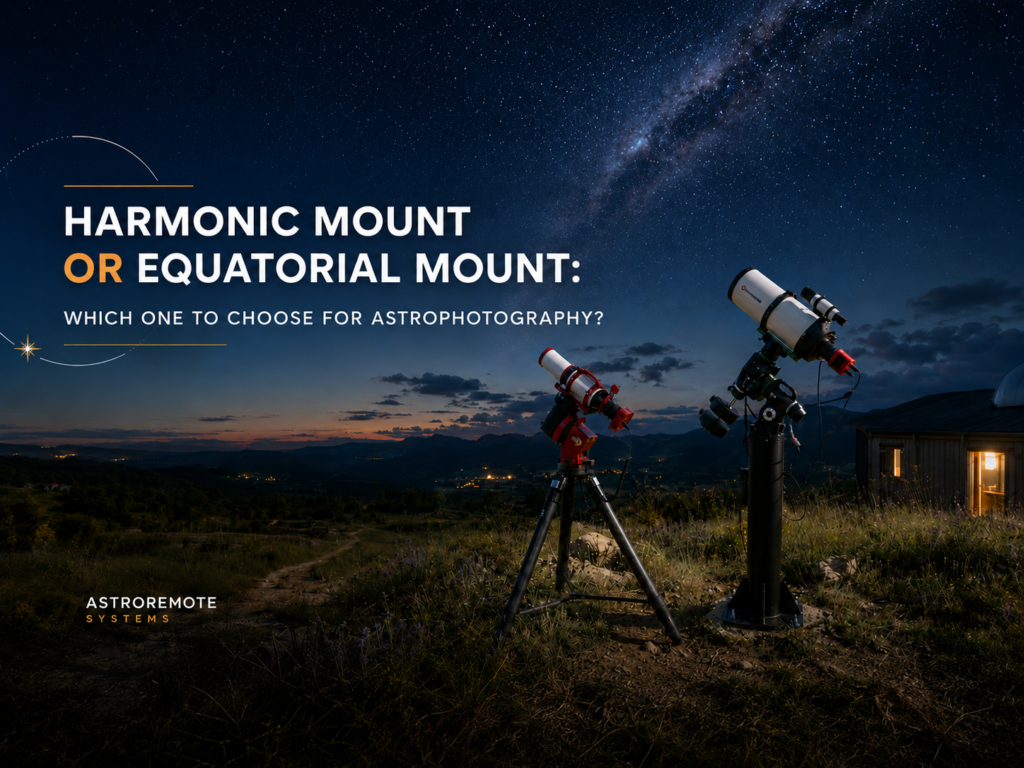
Over the past few years, harmonic drive mounts have significantly disrupted the amateur astrophotography market. Models such as the ZWO AM5N, Pegasus NYX-101, and iOptron HAE69 have demonstrated that it is now possible to carry several dozen kilograms of equipment with a mount weighing less than 6 kg.
Meanwhile, traditional equatorial mounts have certainly not disappeared. Well-established models such as the iOptron CEM70G, Sky-Watcher EQ6-R Pro, EQ8-R, and Losmandy G11 continue to equip numerous amateur observatories and remain highly popular for permanent installations.
This evolution raises an essential question:
Do harmonic mounts truly represent a universal advancement, or do they simply address a specific need?
The answer depends heavily on the intended use.
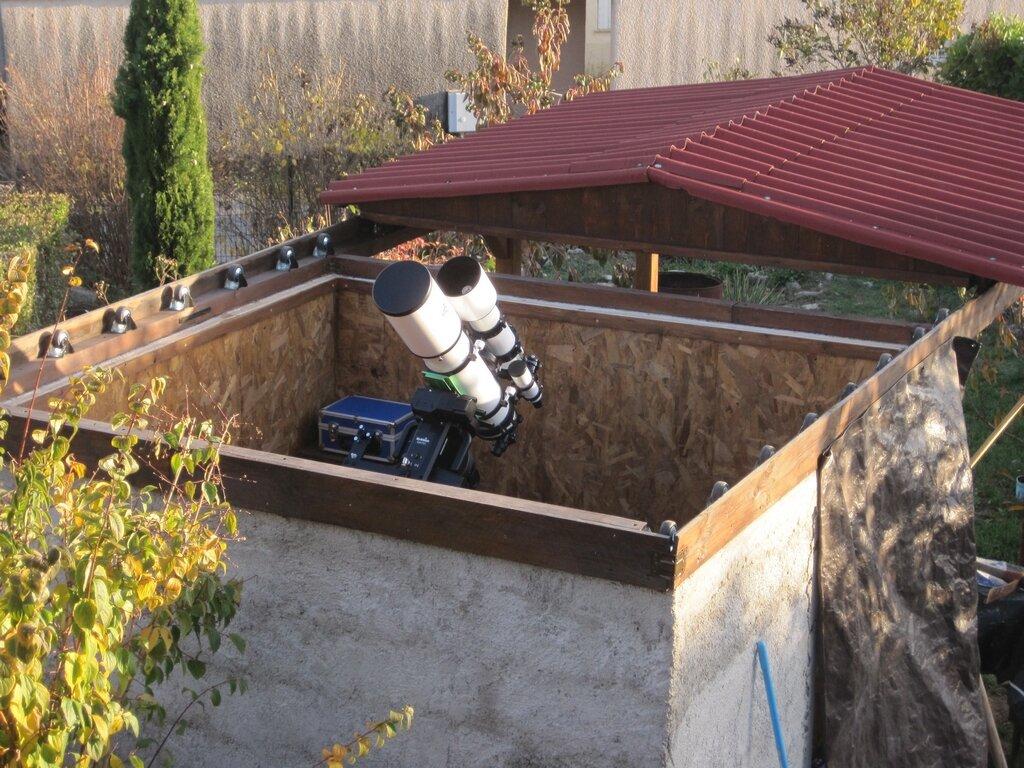
A mount designed to be transported for every imaging session does not face the same constraints as one permanently installed in an automated roll-off roof observatory.
Understanding the Fundamental Mechanical Differences
The Harmonic Drive (Strain Wave Gear)
The core of a harmonic mount is based on a mechanism known as a harmonic drive, or Strain Wave Gear.
The system consists of three main components:
- Circular Spline
- Flex Spline
- Wave Generator
The Wave Generator slightly deforms the Flex Spline, producing an extremely high reduction ratio within a remarkably compact assembly.
The advantages are substantial:
- High torque
- Virtually zero backlash
- Exceptional compactness
- Theoretical elimination of counterweights
However, this architecture also has limitations:
- Often significant periodic error
- High stress concentrated on heavily loaded components
- Strong dependence on autoguiding
- Potential sensitivity to vibrations
A modern harmonic mount may exhibit a native periodic error ranging from ±15 to ±40 arcseconds, sometimes even more.
Fortunately, this error is usually very smooth and predictable, making it relatively easy to correct through autoguiding.
Traditional Worm Gear and Worm Wheel Systems
The technology that has been used for decades relies on a worm gear driving a large toothed wheel.
Its advantages are well known:
- Exceptional robustness
- Slow wear over time
- High mechanical inertia
- Excellent behavior under load
- Extremely long service life
Its drawbacks include:
- Significant weight
- Requirement for counterweights
- Reduced portability
- Larger physical footprint
A properly adjusted mount can achieve relatively low periodic error even without assistance.
Many CEM70G mounts commonly measure between ±3 and ±7 arcseconds.
The best Losmandy and Astro-Physics mounts often perform even better.
The Center-Balanced Equatorial Mount (CEM) Concept
The iOptron CEM70G adopts a unique architecture.
Unlike a traditional German Equatorial Mount, the payload is positioned directly above the mount’s center of gravity.
This design provides:
- Better weight distribution
- Reduced mechanical stress
- Increased structural rigidity
- More efficient use of payload capacity
Today, it remains one of the most attractive architectures for amateur observatories.
Practical Example: A Modern Astrophotography Setup
Consider a representative imaging configuration:
- Askar FRA600 with 0.7x reducer
- APS-C cooled camera
- Filter wheel
- Off-axis guider or guide scope
- Electronic focuser
- Dew heaters
- Mini-PC
- Complete cabling
The total payload typically falls between 8 and 12 kg, depending on the equipment used.
This places the setup comfortably within the ideal operating range of both an AM5N and a CEM70G.
The differences therefore concern less the raw payload capacity and more the overall mechanical behavior.
Profile #1: The Portable or Semi-Portable Astronomer
Weight Changes Everything
An AM5N weighs approximately 5 to 6 kg.
A CEM70G weighs nearly 16 kg.
Once counterweights are added, the difference becomes dramatic.
In practice:
- AM5N + tripod: approximately 10 kg to transport
- CEM70G + counterweights + tripod: often more than 35 kg
For an astronomer who sets up equipment at every session, this quickly becomes a decisive factor.
Counterweight Management
This is probably the greatest advantage of harmonic mounts.
With a setup such as the FRA600:
- No counterweights required
- No meticulous balancing needed
- Simplified deployment
The time savings are real.
Many users reduce setup time from 20 minutes to less than 10 minutes.
Polar Alignment
Both technologies now rely on modern tools such as:
- N.I.N.A.
- SharpCap
- ASIAIR
- Plate solving
The achieved accuracy is comparable.
The difference lies mainly in setup speed.
A harmonic mount requires fewer mechanical adjustments before beginning the alignment procedure.
Wind Sensitivity
This is where limitations begin to appear.
The low mass that represents the primary advantage of harmonic mounts becomes a disadvantage when conditions deteriorate.
In moderate wind:
- A CEM70G remains highly stable
- An AM5N begins to show oscillations more quickly
The difference becomes particularly noticeable with:
- Long focal lengths
- Large optical tubes
- Windy nights
Tracking Performance
Contrary to common misconceptions, modern harmonic mounts guide extremely well.
Users frequently achieve:
- 0.4″ to 0.8″ RMS guiding
A properly adjusted CEM70G can reach similar results.
The difference lies more in consistency.
Traditional mounts tend to deliver more predictable behavior during long imaging sessions.
Power Consumption
The motors must work harder to compensate for the absence of counterweights.
Power consumption is therefore often slightly higher on harmonic mounts.
For battery-powered operation, this can become a consideration.
Verdict for the Portable User
The advantages of harmonic mounts are difficult to ignore:
- Simplified transportation
- Significant time savings
- No counterweights
- Reduced footprint
- Faster deployment
For this user profile, harmonic mounts likely represent the most significant advancement in astrophotography over the past decade.
Profile #2: The Astronomer Operating a Roll-Off Roof Observatory
The situation becomes far more interesting.
Once the mount is permanently installed on a fixed pier, many of the advantages offered by harmonic mounts disappear.
Weight No Longer Matters
In a permanent observatory:
- The mount is never transported
- Counterweights remain permanently installed
- Balancing is performed only once
The primary advantages of harmonic mounts therefore become largely theoretical.
Mechanical Stability Takes Priority
A CEM70G installed on a concrete pier offers:
- Very high inertia
- Excellent vibration resistance
- Better wind tolerance
This stability directly benefits image quality.
Long Automated Imaging Sessions
During a fully automated imaging session managed by N.I.N.A. or equivalent software:
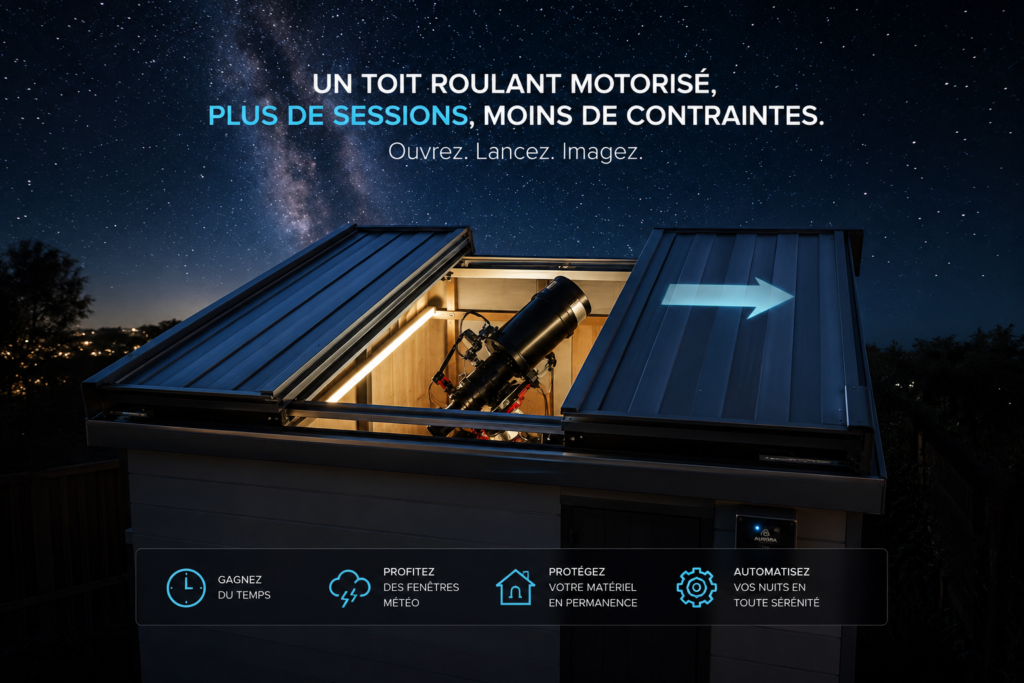
- Automatic roof opening using a controller such as the AURORA 2.0
- Autofocus
- Filter changes
- Meridian flips
- Automatic observatory closure
The priority becomes reliability.
The question is no longer:
“How much does the mount weigh?”
But rather:
“Can it operate without incident for hundreds of nights?”
Long-Term Reliability
Worm-driven mounts benefit from several decades of proven history.
The mechanisms are simple.
Maintenance procedures are well understood.
By contrast, harmonic drives are:
- More complex
- More specialized
- Less documented over 10 to 20-year operating periods
Long-term experience is still limited.
This does not mean they are unreliable.
It simply means that no one currently has statistical data comparable to that available for traditional mount designs.
Equipment Protection
An automated observatory often contains:
- Several thousand euros worth of equipment
- Sometimes well over €10,000 in hardware
Robustness therefore becomes a top priority.
A heavier mount generally provides:
- Reduced vibration
- Less flexure
- Greater mechanical margin
Are Harmonic Mounts Truly an Improvement for Permanent Observatories?
This is arguably the most important question.
The answer is less obvious than marketing materials often suggest.
Elimination of Counterweights
For portable use:
A huge advantage.
For an observatory:
Virtually no impact.
Counterweights remain permanently installed.
Weight Reduction
The same observation applies.
Once mounted on a pier, weight is no longer a problem.
In fact, it often becomes an advantage.
Space Savings
The advantage exists but remains relatively minor.
In a permanent observatory, a few extra centimeters rarely have any practical consequence.
Guiding Performance
Both technologies are now capable of delivering excellent results.
At equivalent payloads, differences often become invisible in final images.
Stability
This is where traditional mounts regain the upper hand.
The combination of:
- Significant mass
- Counterweights
- High inertia
Remains extremely effective at absorbing external disturbances.
Economic Relevance
A question that is rarely discussed.
Why pay more for increased portability when the mount never leaves its pier?
In many cases:
- A CEM70G
- A G11
- An EQ8-R
Will provide greater stability for a comparable or even lower cost.
Direct Comparison: ZWO AM5N vs iOptron CEM70G
ZWO AM5N
Strengths
- Extremely compact
- Very lightweight
- No counterweights required
- Fast setup
- Ideal for portable use
- Excellent ASIAIR integration
Weaknesses
- More sensitive to wind
- Strong dependence on guiding
- Less long-term reliability history
- Reduced benefits in permanent observatories
iOptron CEM70G
Strengths
- Outstanding stability
- Excellent real-world payload capacity
- Efficient CEM architecture
- Excellent guiding performance
- Well suited to permanent observatories
- Excellent for long automated imaging sessions
Weaknesses
- Heavy
- Counterweights required
- Less portable
- Longer setup time
Conclusion
The arrival of harmonic mounts undeniably represents a major advancement for portable astrophotography.
For astronomers who set up their equipment in the backyard for every session, a mount such as the ZWO AM5N genuinely transforms the user experience. The reduction in weight, improved ergonomics, and faster deployment are substantial benefits.
However, when moving to a permanent roll-off roof observatory, the evaluation criteria change completely.
Portability ceases to be a meaningful advantage.
Stability, robustness, mechanical inertia, and long-term reliability become the primary concerns.
In this context, a mount such as the iOptron CEM70G retains compelling advantages and often emerges as the more rational choice.
Final Recommendation
For portable and semi-portable astronomers:
A modern harmonic mount is currently the most practical and comfortable choice.
For astronomers operating a permanent observatory:
A high-quality traditional equatorial mount—and particularly a CEM architecture such as the CEM70G—often remains the most relevant solution from a technical, mechanical, and economic perspective.
The best mount is therefore not necessarily the newest one.
It is above all the mount whose characteristics genuinely match the way its owner intends to use it.
Subscribe to our newsletter
Get early access to our latest articles, practical tips for your astronomical observatory, and exclusive offers.
Ready to Automate Your Observatory?
Aurora 2.0 lets you centralize control of your roll-off roof and seamlessly integrate it into your observatory setup.

Pretty! This was a really wonderful article.
Thank you for providing this info.
Glad you liked the post! Your feedback really motivates us to keep creating useful, top-quality content. Hope to see you back on the blog soon!
Fabien