
Why do some astrophotographers produce 10 times more images than you with the same equipment?
The secret of the most productive astrophotographers: it’s neither the mount nor the camera
When an amateur astronomer decides to build a Roll-Off Roof observatory, an important question quickly arises: should the mount be installed on a permanent pier or simply remain on a traditional tripod?
Both solutions allow astrophotography and visual observing, but they do not meet the same needs. The choice mainly depends on the level of automation desired, the frequency of observatory use, and the performance expected.
The Fixed Pier: The Preferred Solution for Astrophotographers
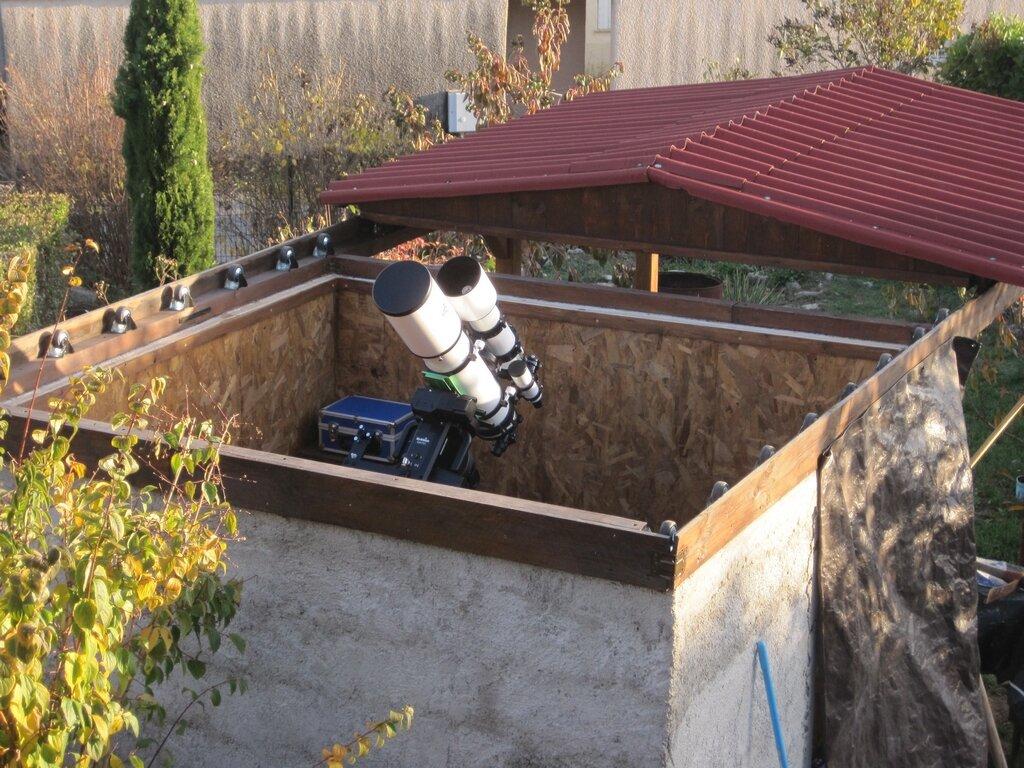
An astronomical pier is a rigid support, usually made of steel or concrete, anchored directly into the observatory foundation. The mount is permanently installed on this pier.
Advantages of a Fixed Pier
Permanent Polar Alignment
The main advantage is obvious: the mount remains perfectly positioned from one session to the next.
Once a precise polar alignment has been completed, it usually remains valid for months or even years without adjustment. This represents a considerable time savings.
Better Mechanical Stability
A properly designed pier provides greater rigidity than most tripods.
Vibrations are reduced, and unwanted movements caused by wind or activity inside the observatory are minimized.
This stability becomes especially important when using:
- Long focal lengths
- Small-pixel cameras
- High-capacity mounts
- Fully automated imaging setups
Time Savings for Every Session
The astronomer simply opens the roll-off roof, powers up the equipment, and begins imaging.
No setup, teardown, or repositioning is required.
Easier Automation
Remote and automated observatories almost always rely on a fixed pier.
The repeatability of the mount position allows:
- Automatic roof opening
- Scheduled imaging sessions
- Automated sequences with N.I.N.A., Voyager, or other software
- Fully unattended operation
Disadvantages of a Fixed Pier
Additional Cost
Building or purchasing a pier represents an extra investment.
Additional requirements often include:
- A suitable base plate
- Strong mounting hardware
- Sometimes concrete or masonry work
Permanent Installation
Once installed, relocating a pier can be difficult.
A positioning mistake or future equipment upgrade may require significant modifications.
The Tripod: The Simple and Economical Solution
The tripod remains the most common solution among amateur astronomers.
Even inside a permanent observatory, some users prefer keeping their mount on its original tripod.
Advantages of a Tripod
Lower Cost
The tripod is usually supplied with the mount.
No additional purchase is required.
Greater Flexibility
The equipment can easily be moved.
The astronomer can:
- Rearrange the observatory layout
- Take the mount to a remote observing site
- Upgrade or sell equipment without major constraints
Quick Installation
No specialized foundation work is required.
For a small observatory or a limited budget, a tripod is often the simplest solution.
Disadvantages of a Tripod
Risk of Accidental Movement
Even in an enclosed observatory, accidentally bumping a tripod leg can slightly alter the mount position.
This may require checking or repeating the polar alignment.
Increased Sensitivity to Vibrations
Vibrations caused by movement inside the observatory can be more noticeable than with an independent pier.
This effect becomes particularly visible when imaging at long focal lengths.
Less Suitable for Full Automation
For an observatory designed to operate autonomously, a tripod has certain limitations.
Mechanical repeatability is generally lower than with a permanently installed pier.
Quick Comparison
| Criteria | Fixed Pier | Tripod |
|---|---|---|
| Initial Cost | Higher | Lower |
| Stability | Excellent | Good to Very Good |
| Polar Alignment Retention | Excellent | Variable |
| Automation | Ideal | Possible but Less Optimal |
| Mobility | Very Low | Excellent |
| Installation Simplicity | Moderate | Very Easy |
| User Comfort | Excellent | Good |
Why a Fixed Pier Unlocks the Full Potential of an Automated Observatory
One of the main goals of a roll-off roof observatory is to simplify access to the night sky. The fewer preparation steps required, the more the astronomer can actually enjoy the observatory.
This is precisely where the fixed pier becomes invaluable.
A System That Is Always Ready
With a mount installed on a permanent pier, the entire setup retains its configuration from one night to the next:
- Polar alignment
- Balance
- Cable routing
- Accessory positioning
The astronomer no longer needs to spend valuable time preparing equipment before every session. Once the roof is open, imaging can begin immediately.
More Reliable Automation
Modern astrophotography software such as N.I.N.A., Voyager, and Ekos can now automate nearly every aspect of an imaging session:
- Automatic target acquisition
- Autofocus
- Plate-solving centering
- Filter changes
- Meridian flips
- Automatic observatory closure at the end of the session
For these automated processes to operate reliably, the mechanical configuration must remain as stable as possible. A fixed pier provides the consistency sought by astrophotographers who want to fully exploit their observatory.
Higher Productivity Under the Stars
Available clear-sky time is often limited.
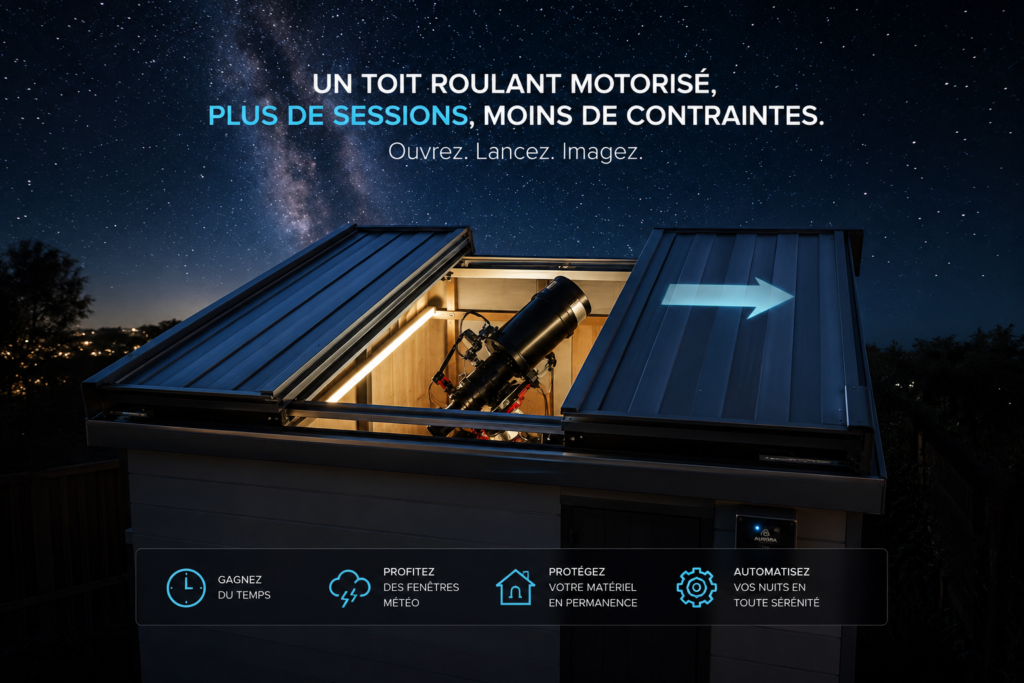
When an observatory is equipped with a fixed pier and a motorized roll-off roof, only a few minutes are needed to start a complete imaging session.
This speed allows astronomers to take advantage of even the shortest weather opportunities, including clear periods lasting only one or two hours.
A Natural Step Toward the Smart Observatory
Many amateur astronomers begin with manual operation before gradually adding new features:
- Weather stations
- Safety sensors
- Remote control capabilities
- Camera monitoring
- Automated roof management
Within this evolution, the fixed pier often becomes the most durable and reliable mechanical foundation.
Combined with a modern roll-off roof controller such as Aurora 2.0, it transforms a simple backyard observatory into a true permanent observatory capable of operating quickly, efficiently, and with a level of automation approaching that of professional installations.
Which Solution Should You Choose?
For a roll-off roof observatory primarily dedicated to astrophotography, a fixed pier is generally the most effective solution.
It provides superior stability, greater comfort, and allows users to fully benefit from modern automation software. It is also the configuration adopted by the majority of permanent amateur observatories dedicated to deep-sky imaging.
However, a tripod remains an excellent choice for astronomers seeking greater flexibility or wishing to minimize their initial investment. A robust tripod, properly installed, can still deliver outstanding astrophotography results.
In practice, the choice depends largely on your objectives. An observatory intended for frequent use or remote operation will fully benefit from a fixed pier. Conversely, a more versatile observatory or one intended to evolve gradually can perform perfectly well with a high-quality tripod.
In either case, building a Roll-Off Roof observatory is already a major improvement in convenience for the amateur astronomer. By dramatically reducing setup time, it allows more time to be devoted to what truly matters: observing and imaging the night sky.
Is your observatory project finally ready to take shape?
Fixed pier or tripod? Both solutions can work perfectly well. But if your project goes beyond simply providing shelter for your equipment, and you are considering a permanent observatory that you will use regularly and potentially operate remotely, it may be worth thinking about automation from the very beginning.
A well-designed observatory can gradually reduce the need for manual intervention: the mount stays permanently in place, the equipment is always ready to operate, and the roof can be controlled automatically according to your observing session and weather conditions.
This is precisely where Aurora 2.0 comes in.
Designed for amateur astronomical roll-off roof observatories, Aurora 2.0 allows you to motorize and control your roll-off roof, while integrating with your overall observatory automation setup.
Are you currently thinking about building your own observatory, have you already started drawing up your plans, or is your project simply beginning to take shape?
Then this may be the right time to start thinking about automation when designing your observatory.
Subscribe to our newsletter
Get early access to our latest articles, practical tips for your astronomical observatory, and exclusive offers.